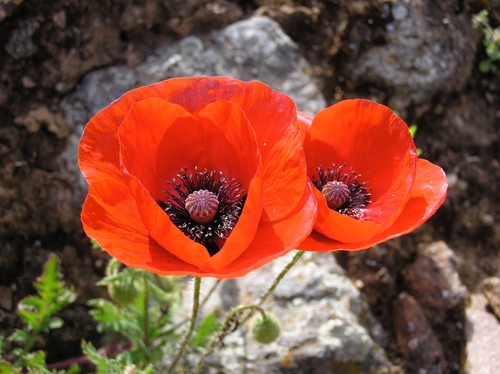
common poppy
Papaver rhoeas
An icon of resilience and beauty, the common poppy paints the landscape in brilliant scarlet. This fleeting wildflower is a master of survival, waiting for years in the soil for its moment to bloom under the summer sun.
Quick Identification
Size
30-100 cm (12-40 inches) in height; flowers 5-10 cm (2-4 inches) across
Colors
Brilliant scarlet red petals, often with a dark black or deep purple patch at the base; stems are a pale, bristly green.
Key Features
- Four large, overlapping papery red petals
- Bristly hairs on the stems and leaves
- Large, urn-shaped seed capsule with a flat disc on top
- Finely divided, feathery green leaves
When You’ll See Them
Geographic range
Where Does the common poppy Live?
The common poppy is natively distributed across North Africa, temperate Eurasia, and the Middle East, with a core presence in countries like the United Kingdom, France, and Turkey. It has successfully naturalized across much of North America, Australia, and parts of South America, often following human agricultural development. Today, it is found on every continent except Antarctica, thriving wherever temperate climates and disturbed ground provide an opportunity for its seeds to sprout.
Basemap © OpenStreetMap contributors
Behavior
The common poppy is a pioneer species, known for its incredible ability to remain dormant in the soil for decades. When the earth is disturbed—whether by a plow, construction, or animal activity—the seeds are exposed to light and oxygen, triggering a sudden and dramatic bloom. This resilience has made the poppy a powerful symbol of remembrance and regrowth across the world.
As a heliotropic plant, the flower heads of the common poppy track the movement of the sun across the sky during the day. This behavior maximizes the warmth within the flower, which helps attract pollinators and speeds up the development of pollen. While the blooms are relatively short-lived, often lasting only a day or two, a single plant can produce hundreds of seeds, ensuring its survival in the landscape for years to come.
EverydayEarth exclusive
Camera Tips
Capturing the common poppy on a backyard camera requires a different approach than filming wildlife. Since poppies are stationary, they are the perfect subjects for time-lapse photography. Set your AI-powered camera to take a photo every 15 to 30 minutes from early morning until late evening. This will allow you to see the remarkable process of the flower head uncurling from its drooping green bud and tracking the sun’s path throughout the day.
For the best visual results, position your camera at a low angle, roughly 12 to 24 inches off the ground. Using a ground spike or a small tripod will allow you to capture the 'under-canopy' of the poppy, where the light shines through the translucent red petals. This 'backlighting' effect makes the flowers appear to glow, creating stunning imagery that stands out in any collection. Avoid placing the camera too far away; a close-up focus on a single cluster of flowers is more effective than a wide shot of a messy field.
If you want to use the poppy as a 'lure' for wildlife, focus your camera on the center of the bloom during peak sun hours. Poppies are massive magnets for pollinators. You are likely to capture high-quality footage of honeybees, bumblebees, and various hoverflies collecting the abundant dark pollen. Ensure your camera's shutter speed is set high if possible, as these insects move quickly, and the thin poppy stems tend to sway even in a light breeze.
Similar Species
Species that look similar or are commonly confused with common poppy.
Frequently Asked Questions
Record common poppy at your habitat
Connect a camera to start building your own species record — AI identifies every visitor automatically.