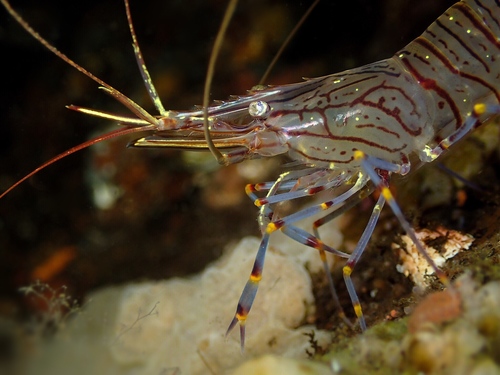
Common Prawn
Palaemon serratus
The ghost of the rocky shore, the Common Prawn is a master of transparency and agility. Watch as these striped scavengers dance through tide pools under the cover of night, using their long antennae to navigate the underwater world.
Quick Identification
Size
Typically 5–11 cm (2–4.3 inches) in length; females are generally larger than males.
Colors
Translucent or pale grey body with distinct reddish-brown or purple horizontal stripes across the abdomen; legs have blue and yellow banding.
Key Features
- Long, upward-curved rostrum (beak) with 6-7 teeth on top
- Two pairs of very long, sensitive antennae
- Translucent body with horizontal dark banding
- First two pairs of walking legs ending in small pincers
When You’ll See Them
Geographic range
Where Does the Common Prawn Live?
The Common Prawn is a native inhabitant of the Eastern Atlantic Ocean, with a core range stretching from the cool coastal waters of Denmark and the British Isles down to the subtropical shores of Mauritania. It is also exceptionally common throughout the Mediterranean Sea and the Black Sea. While they are essentially marine creatures, they are frequently found in brackish estuaries and are a staple of the European Atlantic seaboard's intertidal zones.
Basemap © OpenStreetMap contributors
Behavior
Common Prawns are highly active and opportunistic scavengers that play a vital role in the marine food web. During daylight hours, they are relatively cryptic, spending much of their time tucked away in rocky crevices, under ledges, or deep within seagrass beds to avoid predators like sea bass and gulls. As the sun sets, they emerge to forage, using their long, delicate antennae to sense chemical signals in the water and navigate the lightless environment.
These crustaceans are incredibly agile swimmers. While they usually move forward using their pleopods (swimming legs), they possess a dramatic escape response known as the 'caridoid escape reaction.' When threatened, they rapidly flex their powerful abdomen, snapping their tail fan to propel themselves backward through the water at high speed. Socially, they are often found in loose aggregations, especially where food is abundant or in sheltered tide pools during low tide.
EverydayEarth exclusive
Camera Tips
Capturing the Common Prawn on camera requires a specialized approach, as they are entirely aquatic. If you have a backyard pond connected to a coastal system or are setting up a camera in a tide pool, use a waterproof action camera or a submersible trail camera. Position the camera at the bottom of a rocky pool during low tide, weighting it down with a diving weight or a heavy stone to prevent it from drifting with the incoming tide.
Because prawns are most active at night, your camera must have strong infrared (IR) capabilities or a dedicated underwater light source. Prawns are naturally curious and are often attracted to the glow of white LEDs, but for the most natural behavior, IR is preferred. Angle the camera toward a crevice or a patch of seaweed, as these are the 'highways' prawns use when emerging from their daytime hiding spots.
To guarantee a sighting, use a 'bait bag'—a small mesh pouch filled with crushed mussels, limpets, or a piece of oily fish like mackerel. Secure the bait bag about 30–50 cm (12–20 inches) in front of the lens. This will not only attract prawns but also keep them in the frame while they use their pincers to pick at the food. Set your camera to video mode with a high frame rate (at least 60fps), as their movements—especially the twitching of their antennae and their rapid escape flips—are too fast for standard photo triggers.
Similar Species
Species that look similar or are commonly confused with Common Prawn.
Frequently Asked Questions
Record Common Prawn at your habitat
Connect a camera to start building your own species record — AI identifies every visitor automatically.