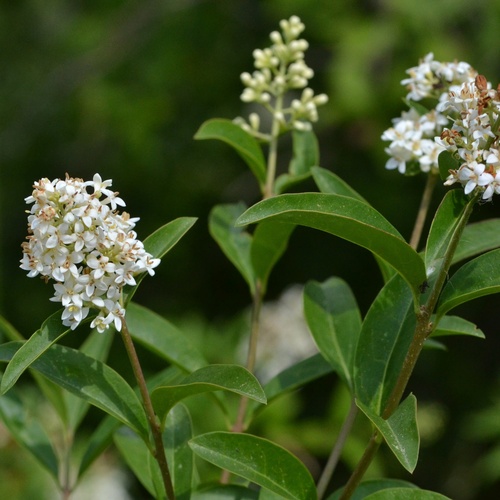
Common Privet
Ligustrum vulgare
A versatile cornerstone of the European countryside, Common Privet offers dense sanctuary and a seasonal feast for pollinators and songbirds alike.
Quick Identification
Size
3-5 meters (10-16 feet) tall with a spread of 2-4 meters (6-13 feet)
Colors
Dark green foliage, creamy white flowers, and glossy black or dark purple berries
Key Features
- Opposite, lance-shaped leaves 2-6 cm long
- Dense panicles of fragrant, tubular white flowers
- Small, bitter black berries that persist into winter
- Grey-brown bark that remains smooth even as it ages
When You’ll See Them
Geographic range
Where Does the Common Privet Live?
Native to the rolling landscapes of Europe, North Africa, and the southwestern reaches of Asia, the Common Privet has a massive footprint that spans from the windswept coasts of Ireland to the highlands of Iran. It thrives across the European continent, particularly in the United Kingdom, France, and Germany, where it has been a hedgerow staple for centuries. Beyond its native range, it has successfully established itself as a naturalized resident in North America and Australia, often found flourishing along the edges of temperate forests and suburban neighborhoods.
Basemap © OpenStreetMap contributors
Behavior
Common Privet is a hardy, fast-growing deciduous to semi-evergreen shrub. While it may appear stationary, it functions as a highly active ecological hub. During the late spring and early summer, it enters a flowering phase where it produces a heavy, sweet scent that acts as a beacon for pollinators. Its growth habit is naturally bushy, providing a complex internal structure of branches that serves as a high-security nursery and sheltering spot for small wildlife.
In the ecosystem of a backyard, the privet plays a dual role of provider and protector. It aggressively competes for space and sunlight, often forming dense thickets if left unpruned. To humans, it is most famous for its tolerance to hedging, but to wildlife, its behavior is defined by its seasonal transition from a nectar source for insects to a winter larder for foraging birds. In some regions outside its native range, its vigorous growth is considered invasive as it can outcompete local flora.
EverydayEarth exclusive
Camera Tips
To capture the wildlife that visits Common Privet, place your camera roughly 3 to 4 feet off the ground and focus on a specific cluster of flowers or berries. During the mid-summer flowering peak, use a fast shutter speed to capture the rapid movements of clearwing moths and various bees that are drawn to the nectar. If your AI camera has a 'small animal' or 'insect' trigger, ensure it is active, as the visitors to privet flowers are often quite small.
In the winter, the privet berries become a focal point for avian activity. Position your camera at a slight downward angle looking at a berry-heavy branch. This is the best time to catch sight of thrushes, waxwings, and blackbirds. Because these birds are often wary, a camera hidden within the foliage of a nearby tree or mounted on a fence post looking into the privet will provide the most natural behavior footage without startling the visitors.
Don't forget to monitor the base of the shrub. The dense, low-hanging branches of a Common Privet hedge create a 'wildlife highway' for ground-dwelling creatures. Set a camera near the ground at the edge of the hedge line to capture hedgehogs, rabbits, or even foxes using the plant as a screen for movement. Use an infrared or night-vision setting here, as many of the mammals using the privet for cover are most active during the twilight and nighttime hours.
Similar Species
Species that look similar or are commonly confused with Common Privet.
Frequently Asked Questions
Record Common Privet at your habitat
Connect a camera to start building your own species record — AI identifies every visitor automatically.