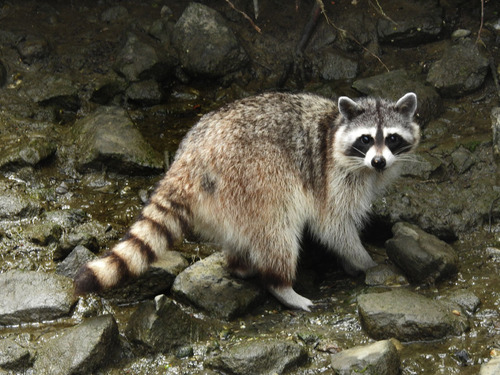
Common Raccoon
Procyon lotor
Meet the backyard's most clever opportunist, the 'masked bandit' known for its incredible dexterity and problem-solving skills. Whether they are raiding a bird feeder or washing a snack in a puddle, Common Raccoons are some of the most entertaining animals you can capture on camera.
Quick Identification
Size
Body length 40-70 cm (16-28 in); weight ranges from 5-26 kg (11-57 lbs) depending on habitat and season
Colors
Grizzled grayish fur with a dense undercoat; iconic black 'mask' around eyes and a bushy tail with 5-7 alternating black and gray rings.
Key Features
- Black mask across eyes
- Ringed tail with 5-7 dark bands
- Extremely dexterous, hand-like front paws
- Stocky build with a distinctively humped posture when walking
When You’ll See Them
Sightings on EverydayEarth
Apr 4, 2026
A Virginia Opossum visits the feeder under the cover of darkness, using its sensitive snout and long whiskers to sift through the seeds. It feeds directly from the tray at very close range, occasionally looking toward the camera lens.
Mar 8, 2026
A Virginia Opossum is foraging in a bird feeder tray at night. It uses its dexterous front paws to sift through a mixture of seeds and mealworms, occasionally dipping its snout into the tray to eat.
Apr 26, 2026
A Northern Raccoon forages through the leaf litter at night, its distinctive ringed tail clearly visible as it sniffs the ground and slowly moves across the forest floor.
Jul 8, 2026
A group of at least five Northern Raccoons is foraging in a wooded clearing during the night. They are seen sniffing through the leaf litter and moving purposefully across the scene, with their distinctive masks and ringed tails clearly visible in the infrared light.
Jul 7, 2026
A group of three raccoons is foraging through the leaf litter in a wooded clearing during the night. They move purposefully across the scene, sniffing the ground for food and occasionally looking directly toward the camera, which highlights their reflective eyes and masked faces.
Jul 16, 2026
A group of raccoons is active in the clearing during the night. They are seen foraging among the leaves, with their eyes reflecting the infrared light. At least four individuals move across the forest floor, displaying their characteristic hunched walking style and masked faces.
Geographic range
Where Does the Common Raccoon Live?
Native to North America, the Common Raccoon is found from the southern reaches of Canada down through the continental United States and into Mexico and Central America as far south as Panama. This resilient mammal thrives in a vast array of environments, from rural woodlands to the heart of major metropolitan cities. Beyond their native shores, they have established significant introduced populations in various parts of Europe, Japan, and the Caucasus region, often stemming from escapes from fur farms or the pet trade.
Basemap © OpenStreetMap contributors
Recorded on EverydayEarth
Behavior
Common Raccoons are celebrated for their remarkable intelligence and adaptability. They are primarily nocturnal, meaning they are most active under the cover of darkness, though it is not uncommon to see them during the day if food is available or if they have young to feed. They are solitary for the most part, but they aren't strictly territorial; related females often share home ranges, and unrelated males may form small groups to maintain their position against rivals during the mating season.
One of their most famous behaviors is 'dousing' or washing their food in water. While it looks like they are cleaning their meal, researchers believe they are actually using the water to increase the tactile sensitivity of their paws. Their front paws are incredibly sensitive and have more mechanoreceptors than most other mammals, allowing them to 'see' with their hands and manipulate latches, jars, and even zippers with ease.
EverydayEarth exclusive
Camera Tips
To capture the best footage of these 'masked bandits,' place your camera low to the ground—ideally between 12 and 18 inches high. Since raccoons are low-slung animals, a camera angled slightly upward from this height captures their facial expressions and hand-like paws as they forage. If you have a water feature like a birdbath or a small pond, point your camera there; raccoons are drawn to water to drink and 'wash' their food, providing excellent opportunities for action shots where they interact with the environment.
Because they are strictly nocturnal, ensure your camera's infrared (IR) or black flash settings are optimized. Raccoons can be wary of 'glow' IR lights (which appear as a faint red light), so using a 'no-glow' or 'black' LED flash is often better for capturing natural behavior without startling them. Set your camera to take short video clips (10-15 seconds) rather than just photos, as their dexterous movements and curious antics are much more interesting to watch in motion than in a static image.
If you want to lure a raccoon into the frame, you don't need much. A small smear of peanut butter on a log or a handful of marshmallows will keep them occupied in front of the lens for several minutes. Just be mindful that attracting raccoons may also attract other visitors like skunks or opossums. For a cleaner approach that doesn't involve food, try hanging a shiny object like a silver spoon or a piece of crinkled foil just within the camera's view; their intense curiosity often drives them to investigate new or reflective objects.
In terms of timing, while they are active year-round, you’ll see the most activity during the warmer months when food is abundant and mothers are out with their kits. In late spring and early summer, look for family groups where the kits follow the mother in a single-file line. During the winter, activity may drop significantly in colder climates as they enter 'torpor'—a deep sleep that isn't quite hibernation—to conserve energy during extreme cold snaps. Check your camera after rainy nights, as the damp ground makes it easier for them to forage for worms and grubs, leading to more activity.
Similar Species
Species that look similar or are commonly confused with Common Raccoon.
Frequently Asked Questions
Record Common Raccoon at your habitat
Connect a camera to start building your own species record — AI identifies every visitor automatically.