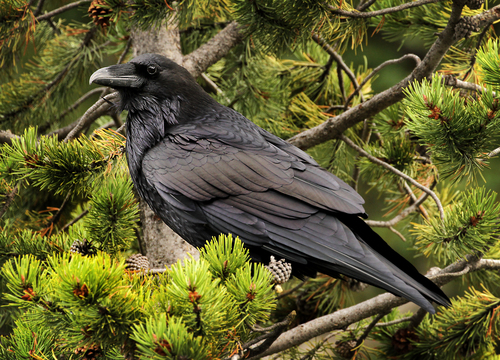
Common Raven
Corvus corax
Meet the most intelligent bird in the Northern Hemisphere. From soaring over mountain peaks to solving puzzles in the backyard, the Common Raven is a master of survival and a legendary trickster.
Quick Identification
Size
Length: 54–67 cm (21–26 in); Wingspan: 115–150 cm (45–59 in); Weight: 0.7–2 kg (1.5–4.4 lb)
Colors
Entirely black plumage with iridescent purple or blue sheen in direct sunlight; black legs, feet, and heavy bill.
Key Features
- Distinctive wedge or diamond-shaped tail
- Large, heavy bill with bristly feathers at the base
- Shaggy throat feathers called 'hackles' that can be puffed out
- Deep, croaking 'gronk-gronk' call unlike a crow's 'caw'
When You’ll See Them
Sightings on EverydayEarth
Aug 1, 2026
A Common Raven is perched on a sun-bleached branch of a large dead tree. It spends its time looking across the landscape and briefly preening its dark feathers under the bright afternoon sun.
Aug 1, 2026
A Common Raven perches on a weathered branch of a large snag, overlooking a dry, golden hillside. The bird remains mostly stationary, occasionally shifting its weight and scanning the valley below under a bright, clear sky.
Aug 1, 2026
A California Condor and two Common Ravens are perched on a weathered tree snag overlooking the Big Sur landscape. The condor rests on a lower limb, its large frame and identification wing tags visible, while the ravens are perched higher up on the dead branches. All three birds remain mostly stationary, occasionally shifting their weight or turning their heads in the bright afternoon sun.
Jul 30, 2026
A California Condor, identifiable by its pink bald head and a yellow wing tag numbered 9, is scavenging on a carcass. A Common Raven is also present, hopping around the left side of the frame and feeding on the same site.
Jul 29, 2026
A California Condor is perched on a wooden branch inside a large outdoor flight pen, occasionally turning its head and shifting its weight. On the mesh roof above, a Common Raven is perched, looking out over the hillside.
Jul 29, 2026
A juvenile California Condor is seen standing on a dry, grassy hillside. A Common Raven lands nearby and hops around the larger bird, likely looking for an opportunity to scavenge from the same spot.
Geographic range
Where Does the Common Raven Live?
The Common Raven is a true global citizen of the Northern Hemisphere, boasting the widest distribution of any member of the crow family. They are native across the vast stretches of North America, Europe, and Asia, as well as parts of North Africa. In North America, they are most prevalent in the West, the North, and the Appalachian mountains, though their range is steadily expanding back into the northeastern United States and suburban environments where they were once rare.
Basemap © OpenStreetMap contributors
Recorded on EverydayEarth
Behavior
Common Ravens are widely considered the most intelligent of all birds, displaying problem-solving skills and social complexities often compared to primates. They are highly acrobatic flyers, frequently seen performing somersaults, rolls, and mid-air tumbles for what appears to be pure play. Unlike their more social cousins, the crows, adult ravens are typically found in mated pairs that defend a specific territory year-round. However, younger 'teenage' ravens are known to form nomadic gangs that travel together in search of food.
These birds are master opportunists with a diverse vocal repertoire, capable of mimicking human speech, mechanical sounds, and other animal calls. In backyard settings, they are cautious but curious. While they may keep a distance from humans, they quickly learn the schedules of people who provide food or leave compost accessible. Their interactions are characterized by a 'wait and see' approach, often watching from a high perch before committing to a landing.
EverydayEarth exclusive
Camera Tips
To capture a Common Raven on camera, think 'wide and high.' Ravens are significantly larger than most backyard birds and are notoriously wary of new objects on the ground. Mount your camera 5 to 8 feet high on a sturdy post or tree trunk, angled slightly downward to capture a broad field of view. Because they are cautious, it may take several days for a raven to trust a camera placement; avoid moving the device once it is set up.
Ravens are attracted to high-protein rewards and shiny objects. If you are using a trail camera in a legal area, placing scrap meat or suet in a secure cage can draw them in. However, they are also attracted to 'curiosity lures.' A bright silver spoon or a small mirror placed in the camera's focal zone can pique their investigative nature, leading to incredible close-up shots of them inspecting the object.
Use a fast trigger speed (0.5 seconds or less) and a multi-shot burst mode. Ravens are rarely still; they hop, tilt their heads, and flick their wings constantly. A burst of 3-5 photos ensures you catch that perfect moment where the sun hits their iridescent feathers. Ensure your camera is set to its highest resolution, as the fine detail of their throat hackles is what truly distinguishes a raven from a crow in photographs.
Similar Species
Species that look similar or are commonly confused with Common Raven.
American Crow
Smaller with a fan-shaped tail and a smoother throat; has a higher-pitched 'caw' vocalization.
Chihuahuan Raven
Nearly identical but slightly smaller; found only in the Southwestern US and Mexico; possesses white bases on neck feathers.
Rook
Found in Europe and Asia; distinguished by a patch of bare, grey-white skin at the base of the bill in adults.
Frequently Asked Questions
Record Common Raven at your habitat
Connect a camera to start building your own species record — AI identifies every visitor automatically.