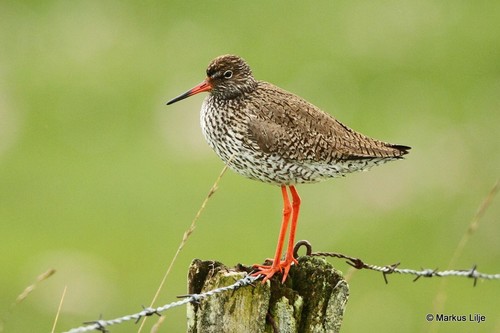
Common Redshank
Tringa totanus
With its unmistakable bright orange legs and a piercing alarm call that earns it the nickname 'Sentinel of the Marshes,' the Common Redshank is a vibrant highlight of Eurasian wetlands. This elegant wader is a favorite for backyard observers living near coastal or marshy habitats.
Quick Identification
Size
Length: 27–29 cm (10.6–11.4 in); Wingspan: 45–52 cm (17.7–20.5 in); Weight: 85–155 g (3–5.5 oz)
Colors
Brownish-grey upperparts with dark streaks; white underparts with heavy spotting; iconic bright orange-red legs and a red base to the bill.
Key Features
- Bright orange-red legs and bill base
- Distinctive white 'wedge' on the rump and white trailing edges on wings in flight
- Loud, musical 'tuh-hu-hu' whistling call
- Medium-length, straight bill
When You’ll See Them
Geographic range
Where Does the Common Redshank Live?
Native to the temperate and subarctic regions of Eurasia, the Common Redshank boasts an expansive range that stretches from the rugged coastlines of Iceland and the British Isles across the European continent to the vast wetlands of China and Siberia. During the winter months, many populations migrate south to the warmer shores of the Mediterranean, Africa, and South Asia, while some hardy individuals remain year-round in Western Europe. This broad distribution ensures they are a staple sight for birdwatchers across the Old World's estuaries and inland marshes.
Basemap © OpenStreetMap contributors
Behavior
The Common Redshank is famously known as the 'Sentinel of the Marshes.' It is a highly wary bird, often the first to spot an intruder and let out a piercing, flute-like alarm call that alerts all other wildlife in the vicinity. This vocal nature makes them one of the most conspicuous shorebirds in their habitat, especially during the breeding season when they perch on fence posts or mounds to survey their territory.
During the day, they are often seen 'bobbing' their bodies up and down—a characteristic nervous movement. They are semi-social birds, frequently seen in small flocks during the winter, though they maintain individual feeding territories. Their flight is rapid and erratic, characterized by clipped wingbeats that highlight their striking white wing markings.
EverydayEarth exclusive
Camera Tips
To capture high-quality footage of a Common Redshank, camera placement is critical. Because they are ground-probing feeders, you should position your AI-powered camera very low to the ground—ideally just 6 to 12 inches above the substrate. Aim the lens at a muddy shoreline or a shallow pool edge where the water is no more than two inches deep. If you are in a tidal area, ensure your camera is securely mounted on a stake or tripod that can withstand the environment, and always place it above the high-tide mark to avoid equipment damage.
While you cannot easily bait shorebirds with seeds or nuts, you can attract them with environment modification. Maintaining a 'scuff' of exposed, wet mud in a backyard wetland or near a pond is a powerful lure. The sound of moving water is also a significant attractant; a solar-powered water dripper that creates ripples and small splashes can draw a Redshank in to investigate or bathe. These birds prefer open sightlines, so avoid placing your camera in thick reeds; instead, look for an open patch of mud with a clear view.
For camera settings, speed is your best friend. Common Redshanks are energetic and prone to sudden flight. Set your camera to its fastest trigger speed (0.2 seconds if possible) and use a 'burst' or 'multi-shot' mode to capture 3-5 photos per trigger event. This increases your chances of getting a clear shot of their distinctive white wing bars or their characteristic bobbing motion. If your camera supports high-frame-rate video, 60fps is ideal for slowing down their rapid wingbeats during takeoff.
Timing your monitoring is essential. In coastal regions, Redshanks follow the rhythm of the tides; they are most active near the camera when the rising tide pushes them toward the shore or when the falling tide first reveals fresh mud. If you are inland, focus your 'active' hours on the 'golden hours' of dawn and dusk, when their silhouette against the water can produce stunning, professional-grade imagery.
Similar Species
Species that look similar or are commonly confused with Common Redshank.
Frequently Asked Questions
Record Common Redshank at your habitat
Connect a camera to start building your own species record — AI identifies every visitor automatically.