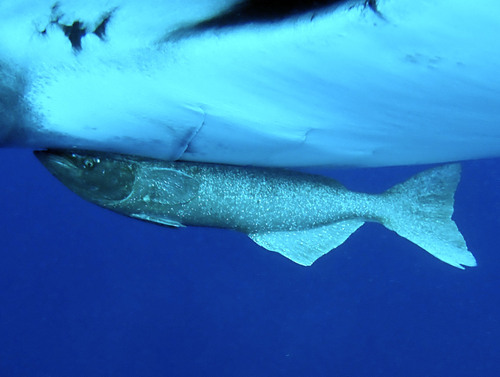
Common Remora
Remora remora
The ultimate hitchhiker of the high seas, the Common Remora uses a unique suction-disk head to travel the world's oceans on the backs of sharks and giants.
Quick Identification
Size
Typically 30 to 60 cm (12 to 24 inches), though they can reach a maximum length of 86 cm (34 inches) and weigh up to 1.1 kg (2.4 lbs).
Colors
Uniformly dark charcoal, brownish-black, or dusky grey; unlike some relatives, they lack distinct lateral stripes or white fin edges.
Key Features
- Large oval-shaped suction disk on top of the head
- Flattened head profile with a protruding lower jaw
- Streamlined, slender body with a slightly forked or square tail
When You’ll See Them
Geographic range
Where Does the Common Remora Live?
The Common Remora is a truly global citizen of the sea, native to the tropical and warm-temperate waters of every major ocean on Earth. They are most concentrated in the Atlantic, Pacific, and Indian Oceans, ranging as far north as the coast of Canada and the North Sea, and as far south as Argentina and New Zealand. Because they rely on migratory hosts like sharks and billfish, their presence is widespread across both offshore pelagic zones and coastal reef systems.
Basemap © OpenStreetMap contributors
Behavior
The Common Remora is famous for its symbiotic relationship with larger marine life. Using a highly modified dorsal fin that functions as a powerful suction cup, it attaches itself to sharks, rays, large bony fish, sea turtles, and even whales. This 'hitchhiking' behavior allows the remora to travel long distances without expending energy while benefiting from the protection of a much larger predator.
While they are often viewed as mere passengers, the relationship is frequently mutualistic. Remoras act as cleaners, eating parasites and dead skin off their hosts. They are also skilled swimmers in their own right and will detach to forage independently or find a new host. They are generally solitary but may be found in small groups attached to a single large host like a Whale Shark.
EverydayEarth exclusive
Camera Tips
Capturing a Common Remora on camera requires specialized underwater equipment, but for those with 'blue backyards'—such as coastal docks, piers, or boat slips—it is an achievable and rewarding challenge. Use a waterproof action camera or a dedicated underwater trail camera. If you have a permanent dock, mount the camera 1-2 meters below the low-tide line, angled slightly upward to catch the silhouettes of passing hosts like rays or sharks, which the remoras will be attached to.
To attract remoras specifically, you can use a perforated bait box filled with oily fish scraps like sardines or mackerel. While the remora might be interested in the scraps, the bait is more likely to attract a host animal, bringing the remora along for the ride. High-frame-rate settings are essential, as these fish move rapidly when detaching or darting for food scraps. Ensure your camera is set to a wide-angle lens to capture the full scale of the host and its hitchhikers.
Visibility is key, so the best footage is usually captured during the middle of the day when the sun is directly overhead, providing the best natural light penetration. If you are filming under a dock or in murkier water, consider adding a small, diffused underwater LED light. Be mindful of biofouling; if your camera stays submerged, the lens will need to be cleaned every few days to remove algae and barnacle growth.
Frequently Asked Questions
Record Common Remora at your habitat
Connect a camera to start building your own species record — AI identifies every visitor automatically.