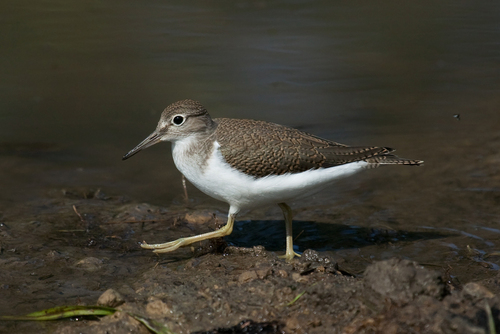
Common Sandpiper
Actitis hypoleucos
The Common Sandpiper is a tireless traveler of the world's waterways, instantly recognizable by its rhythmic tail-bobbing and distinctive white shoulder wedge. Whether on a remote Siberian river or a suburban canal, this energetic wader is a joy to observe.
Quick Identification
Size
Length: 19–21 cm (7.5–8.3 in), Wingspan: 32–35 cm (12.6–13.8 in), Weight: 37–65 g (1.3–2.3 oz)
Colors
Olive-brown upperparts with subtle dark streaks; clean white underparts with a characteristic white 'wedge' extending up the shoulder. Legs are pale grey or yellowish-green.
Key Features
- Constant 'teetering' or bobbing of the tail while standing
- Distinctive white shoulder wedge visible in front of the wing
- Flickering flight style with stiff, bowed wings low over water
- White eye-ring and pale eyebrow stripe
- Rhythmic, piping 'twee-twee-twee' call
When You’ll See Them
Geographic range
Where Does the Common Sandpiper Live?
Native to the Palearctic region, the Common Sandpiper breeds across a vast territory stretching from the United Kingdom and Scandinavia across Europe and Russia to Japan. When winter arrives, these birds embark on a significant migration to warmer climates, wintering throughout Sub-Saharan Africa, Southern Asia, and as far south as Australia. Because they are highly adaptable, they can be found in almost any country within these regions that offers suitable freshwater or brackish habitat.
Basemap © OpenStreetMap contributors
Behavior
The Common Sandpiper is most famous for its restless energy. It is rarely seen standing still, almost constantly 'teetering'—bobbing its rear end up and down in a rhythmic motion. This behavior is thought to help the bird better judge distances or perhaps flush out prey. When flushed, it flies low over the water with a very distinctive flight pattern: short bursts of rapid, stiff wingbeats interspersed with brief glides on bowed wings, often accompanied by a high-pitched piping call.
While they are migratory, they are relatively solitary compared to other wading birds. You will usually see them alone or in pairs rather than in large flocks. They are quite bold and can often be found near human activity, such as on canal towpaths or near park ponds, provided there is a bit of muddy or stony shoreline to forage on. They are territorial during the breeding season and will actively defend their stretch of riverbank from rivals.
EverydayEarth exclusive
Camera Tips
To capture the Common Sandpiper on camera, location is everything. These birds are 'edge specialists' that walk along the very margin where water meets land. Position your camera just 6 to 12 inches above the ground, aimed at a flat, stony, or muddy section of a riverbank or pond edge. Use a wide-angle setting if possible, or ensure the camera is far enough back to capture the shoreline, as these birds tend to move quickly along the water's edge rather than staying in one spot.
Because the Common Sandpiper is small and moves with a fast, jerky motion, a high trigger speed is essential. Set your camera to a 'Burst' or 'Multi-shot' mode with at least 3 photos per trigger. This increases your chances of catching the bird with its head up or in mid-teeter. If your camera supports it, high-definition video is actually the best way to document this species, as its identifying tail-bobbing behavior is much easier to see in motion than in a still photo.
Avoid placing cameras in areas with tall, swaying reeds that might cause false triggers. Instead, look for 'natural stages' like a large, flat rock or a partially submerged log. Sandpipers often use these as lookout points or to cross over deep water. Since they are diurnal (active during the day), you don't need to worry about infrared flash quality as much as shutter speed to prevent motion blur in bright daylight. If you are setting up in a backyard with a pond, placing a few flat stones right at the waterline will create an irresistible foraging spot for them.
Similar Species
Species that look similar or are commonly confused with Common Sandpiper.
Green Sandpiper
Darker, almost blackish wings and a brilliant white rump that is very obvious in flight; lacks the white shoulder wedge.
Spotted Sandpiper
The American sister species; breeding adults have distinct large black spots on the breast, while Common Sandpipers have streaked or plain white breasts.
Wood Sandpiper
Has much longer, yellowish legs and a more heavily speckled 'spangled' back, with a prominent white stripe above the eye.
Frequently Asked Questions
Record Common Sandpiper at your habitat
Connect a camera to start building your own species record — AI identifies every visitor automatically.