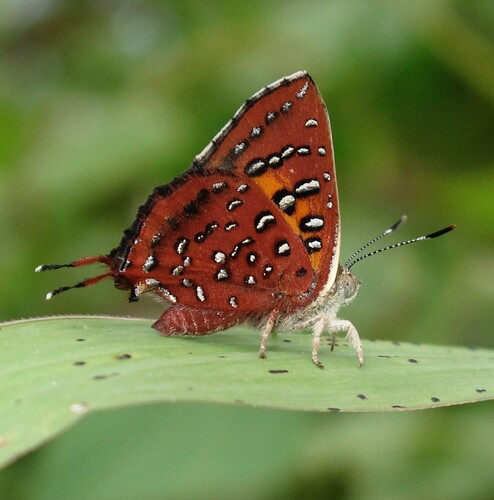
Common Scarlet
Axiocerses harpax
A flash of fire in the African savanna, the Common Scarlet is a dazzling butterfly known for its brilliant red wings and unique partnership with ants.
Quick Identification
Size
Wingspan of 24–30 mm (0.9–1.2 in) for males and 26–36 mm (1.0–1.4 in) for females
Colors
Brilliant scarlet to orange-red upper wings with thick black borders; underside is a complex mosaic of reddish-brown, silver, and black spots.
Key Features
- Vivid scarlet-red upper wings with prominent black margins
- Two small, delicate tails on the hindwings
- Mottled underside with silver-grey and brown camouflage
- Fast, skipping flight pattern low to the ground
When You’ll See Them
Geographic range
Where Does the Common Scarlet Live?
The Common Scarlet is a quintessential African butterfly, native to the vast landscapes of Sub-Saharan Africa. Its presence stretches from the southern tips of South Africa and Zimbabwe through the East African highlands of Kenya and Ethiopia, reaching across the tropical belts of Nigeria and Ghana. While it thrives in wild savannas, it has successfully adapted to human-altered landscapes, making it a frequent visitor to suburban gardens and parklands throughout its massive continental range.
Basemap © OpenStreetMap contributors
Behavior
The Common Scarlet is a sun-loving butterfly known for its energetic and territorial behavior. During the heat of the day, males are frequently seen perching on the tips of leaves or twigs in prominent, sunny spots. From these vantage points, they aggressively defend their territory against other males and intercept passing females. Their flight is remarkably fast and erratic, making them appear as a sudden flash of red before they disappear against the vegetation.
A fascinating aspect of their life cycle is their symbiotic relationship with ants, a common trait in the Lycaenidae family. The larvae (caterpillars) possess specialized glands that secrete a sugary fluid to feed specific ant species. In exchange, the ants provide protection from predators and parasites. The adults are primarily nectar feeders, frequenting a variety of low-growing flowers and flowering shrubs within their savanna habitat.
EverydayEarth exclusive
Camera Tips
To capture the Common Scarlet on an AI-powered backyard camera, you must focus on 'hotspots' like host plants or favorite nectar sources. Because these butterflies are small and move quickly, place your camera within 12 to 24 inches of flowering shrubs such as Buddleja or Lantana. If your camera has a macro lens or adjustable focus, this is the time to use it to capture the intricate silver-spotted patterns on the underside of their wings.
Males are creatures of habit and will often return to the exact same 'perch'—usually a sunlit leaf on the edge of a bush—after chasing away an intruder. If you notice a butterfly repeatedly landing on a specific twig, mount your camera facing that perch. Position the lens so it is level with the leaf to get a profile shot that showcases the contrast between the fiery red upper wings and the camouflaged underside.
Lighting is critical for this species. They are most active during full sun, which can cause harsh glares on their iridescent wings. Try to position your camera so the sun is behind it or slightly to the side to avoid washing out the deep scarlet hues. Since they are cold-blooded, early morning is a great time to catch them resting with wings open to soak up the sun's warmth, providing the perfect still-shot opportunity before they become too active.
Similar Species
Species that look similar or are commonly confused with Common Scarlet.
Frequently Asked Questions
Record Common Scarlet at your habitat
Connect a camera to start building your own species record — AI identifies every visitor automatically.