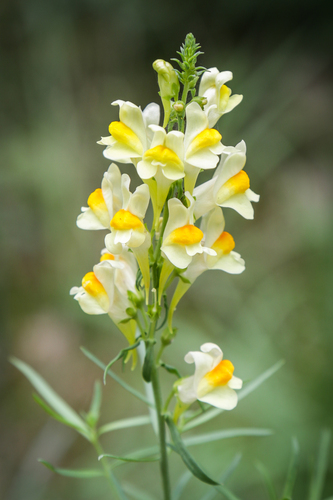
common toadflax
Linaria vulgaris
Affectionately known as 'Butter and Eggs,' common toadflax is a striking wildflower that mimics the look of a garden snapdragon. Its unique spurred blooms are a masterclass in nature's engineering, designed specifically for the strongest pollinators.
Quick Identification
Size
15 to 90 cm (6 to 35 inches) tall; flowers are 2.5 to 3 cm (1 inch) long including the spur.
Colors
Pale yellow petals with a distinct bright orange 'palate' or bulge on the lower lip; leaves are a glaucous blue-green.
Key Features
- Snapdragon-like flowers with a long, downward-pointing spur
- Distinctive 'butter and eggs' yellow and orange coloration
- Narrow, grass-like leaves arranged spirally on the stem
- Dense terminal clusters of flowers (racemes)
When You’ll See Them
Geographic range
Where Does the common toadflax Live?
Native to the temperate regions of Europe and Northern Asia, common toadflax has expanded its footprint across the globe. It is now widely established throughout North America, from the sub-boreal regions of Canada to the southern United States, where it was originally introduced as an ornamental and medicinal herb. This hardy plant thrives in almost any sunny, well-drained environment across the Northern Hemisphere.
Basemap © OpenStreetMap contributors
Behavior
Common toadflax is a perennial wildflower known for its remarkable resilience and its specialized relationship with pollinators. While it remains stationary, it 'behaves' opportunistically by spreading through a vigorous, creeping root system that allows it to form dense colonies. The flower itself is a masterpiece of mechanical design; the 'mouth' of the bloom is tightly closed to keep out smaller, nectar-robbing insects, requiring a heavy-bodied bee to physically force it open.
In the garden ecosystem, common toadflax acts as a critical late-season nectar source. It is particularly important for bumblebees, which have the strength and the long tongues necessary to reach the nectar hidden at the back of the floral spur. Despite its beauty, it is often viewed with mixed emotions by humans; in its native range, it is a beloved heritage plant, while in North America, its aggressive growth in disturbed soils has earned it a reputation as a persistent, though attractive, weed.
EverydayEarth exclusive
Camera Tips
To capture the beauty of common toadflax and its visitors, place your AI-powered camera on a low-profile stake or ground mount. Aim for a lens height of about 12 to 20 inches, focusing directly on a healthy cluster of flower spikes. Because the plant's movement is limited to swaying in the wind, ensure your camera's motion sensitivity is calibrated to avoid 'false triggers' from the stems, while remaining sensitive enough to catch the rapid arrival of bumblebees and hoverflies.
Lighting is crucial for this species. The pale yellow petals can easily become overexposed in direct midday sun, washing out the delicate orange details. For the best results, position your camera to face south or west, capturing the warm light of the late afternoon 'golden hour' which makes the translucent flowers appear to glow from within. If your camera has a macro mode, use it to highlight the intricate spur at the base of the flower.
Since common toadflax is a major draw for long-tongued bees, consider setting your camera to 'Burst Mode' or 'High-Speed Video.' This will allow you to see the fascinating process of a bumblebee prying open the 'mouth' of the flower—a behavior that happens in a split second. Keep the area immediately behind the plant clear of busy backgrounds to help your AI accurately identify the visiting insects against the blue-green foliage.
Similar Species
Species that look similar or are commonly confused with common toadflax.
Frequently Asked Questions
Record common toadflax at your habitat
Connect a camera to start building your own species record — AI identifies every visitor automatically.