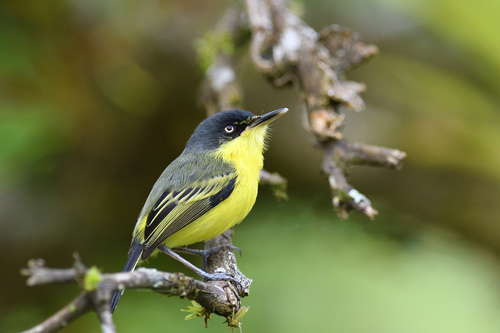
Common Tody-Flycatcher
Todirostrum cinereum
Meet the tiny powerhouse of the tropical garden. With its striking white eyes and an unmistakable side-to-side tail waggle, the Common Tody-Flycatcher is a favorite for backyard birders from Mexico to Argentina.
Quick Identification
Size
9.5-10.2 cm (3.7-4.0 in) in length; weighs 6.5-8 g (0.23-0.28 oz)
Colors
Slaty-black crown and face; olive-green back; bright yellow underparts; black wings with two yellow bars; distinct pale-white to yellow iris
Key Features
- Striking pale white or yellow iris
- Broad, flat, shovel-shaped bill
- Cocked tail often wagged side-to-side
- Slaty-black head contrasting with yellow belly
When You’ll See Them
Geographic range
Where Does the Common Tody-Flycatcher Live?
This bird is a quintessential Neotropical resident, native to the vast stretch of land from southern Mexico through Central America and across most of South America. Its core range covers every mainland South American country except for Chile and Uruguay, thriving in the Amazon basin, the Caribbean coast, and the subtropical regions of northern Argentina. Because it prefers open edges over deep, dark forests, it has expanded its presence as tropical landscapes have become more fragmented and suburbanized.
Basemap © OpenStreetMap contributors
Behavior
The Common Tody-Flycatcher is a hyperactive bird that rarely stays in one spot for long. It is most famous for its peculiar 'waggle'—a rhythmic, side-to-side movement of its cocked tail that occurs while the bird is perched or foraging. These birds are usually found in pairs, maintaining contact with a series of sharp, clicking 'chip' notes as they move through the mid-canopy of trees or garden shrubs.
Unlike many other tyrant flycatchers that sit and wait for insects to fly by, the Tody-Flycatcher uses a 'snatch-gleaning' technique. It hops through foliage, suddenly hovering to pluck a spider or beetle from the underside of a leaf. Because they are bold and adapt well to human presence, they are a frequent sight in suburban backyards and urban parks, where they may even build their distinctive hanging nests right next to a patio or walkway.
EverydayEarth exclusive
Camera Tips
To successfully capture a Common Tody-Flycatcher on your backyard camera, you must think vertically. These birds are edge specialists that rarely descend to the ground, so mounting your camera at eye level—between 5 and 7 feet high—is essential. Aim the lens toward the outer branches of flowering shrubs or fruit trees, where the birds spend their time searching for insects. Because they are tiny and move with jerky, rapid motions, ensure your camera is set to a high-speed capture mode or has a fast trigger speed to avoid getting nothing but a blurry yellow streak.
Water is your most effective lure. While they won't visit a seed tray, they are very fond of misting systems or shallow birdbaths placed near dense cover. A camera positioned near a water source with good morning light will help highlight their most striking feature: the pale white iris. Try to orient the camera so it faces away from the sun to prevent silhouetting, which can wash out the subtle olive tones of their back.
Keep an eye out for their unique nesting habits. They build long, hanging pouch-like nests made of moss, plant fibers, and spiderwebs, often suspended from a thin drooping branch. If you notice a pair building a nest, positioning a trail camera 10-15 feet away can provide incredible footage of their social interactions. Just be sure to use a focal length that doesn't require getting too close, as you don't want to disturb the breeding pair or lead predators to the nest site.
Similar Species
Species that look similar or are commonly confused with Common Tody-Flycatcher.
Frequently Asked Questions
Record Common Tody-Flycatcher at your habitat
Connect a camera to start building your own species record — AI identifies every visitor automatically.