Common Torpedo
Torpedo torpedo
Meet the ocean's living battery. The Common Torpedo is an electrifying ambush predator that hides in plain sight beneath the Mediterranean sands, waiting for the perfect moment to strike.
Quick Identification
Size
Up to 60 cm (24 in) in length; weighs approximately 2-4 kg (4.4-8.8 lbs).
Colors
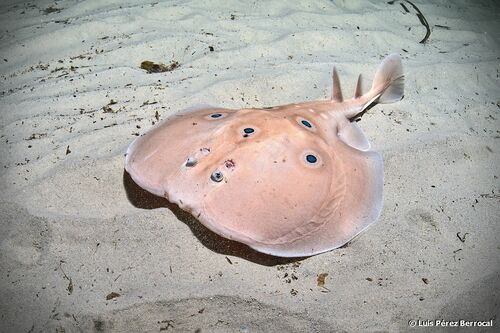
Brownish to reddish-brown upper surface with five large, bright blue spots (ocelli) ringed in black; creamy white underside.
Key Features
- Nearly circular pectoral fin disc
- Five prominent blue 'eye' spots on the back
- Short, thick tail with two dorsal fins
- Small knob-like papillae on the spiracle rims
When You’ll See Them
Geographic range
Where Does the Common Torpedo Live?
The Common Torpedo is native to the temperate and tropical waters of the Eastern Atlantic and the entire Mediterranean basin. Its range stretches from the Bay of Biscay in the north, down the coast of West Africa as far south as Angola. It is most frequently encountered in the warm coastal shallows of Italy, Greece, and North Africa, where it thrives in sheltered bays and lagoons.
Basemap © OpenStreetMap contributors
Behavior
The Common Torpedo is a master of patient ambush. It spends the majority of its daylight hours buried beneath a thin layer of sand or fine mud, with only its eyes and breathing spiracles protruding. By blending perfectly with the seafloor, it avoids detection from both predators and its own unsuspecting prey. This ray is solitary by nature and highly territorial regarding its preferred 'hidey-holes' in the substrate.
Equipped with specialized hexagonal muscle cells called electrocytes, this species can generate an electric discharge ranging from 30 to 45 volts. It uses these shocks primarily for hunting, wrapping its pectoral fins around a fish and delivering a pulse to stun it instantly. While they are generally docile toward humans, they will deliver a defensive shock if stepped on in shallow water, which is startling but rarely dangerous to healthy adults.
EverydayEarth exclusive
Camera Tips
Capturing a Common Torpedo on camera requires an underwater trail camera or a waterproof housing capable of enduring the corrosive nature of saltwater. For the best results, place your camera just 10–20 centimeters off the seafloor on a weighted tripod. Angle the lens slightly downward toward a patch of open sand near the edge of a seagrass bed, as these are the ray's primary hunting grounds. Because they are almost exclusively nocturnal, ensure your camera is equipped with a high-intensity infrared (IR) flash to capture clear monochromatic footage without scaring the fish with visible light.
To successfully attract a Common Torpedo to your lens, use a scent-based lure. A mesh 'chum' bag filled with crushed sardines or squid tied to a stake in front of the camera works wonders. These rays have an incredibly sensitive sense of smell and will emerge from the sand to investigate the source of the protein. Be sure to secure the bait bag firmly, as crabs or larger eels may try to drag it away before the ray arrives.
When setting your camera, use a fast trigger speed and a high frame rate. The Common Torpedo’s strike—where it leaps from the sand and envelopes its prey—is remarkably quick. If you are using video mode, set the clip length to at least 20 seconds; these rays often hover over a spot for a moment to 'scan' with their electro-receptors before settling back into the sand. In the summer months, focus your efforts in very shallow water (1-3 meters), as this is when they move closest to shore to breed.
Frequently Asked Questions
Record Common Torpedo at your habitat
Connect a camera to start building your own species record — AI identifies every visitor automatically.