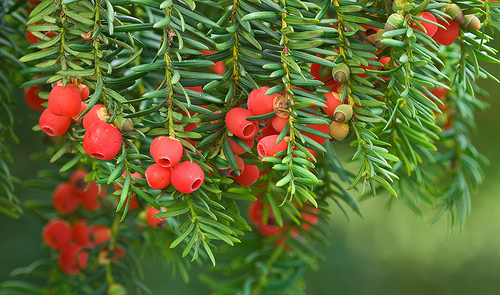
common yew
Taxus baccata
A symbol of immortality and ancient mystery, the common yew is an evergreen icon of the European landscape. Known for its toxic needles and life-giving red berries, it serves as a vital sanctuary for backyard birds.
Quick Identification
Size
Typically 10–20 metres (33–66 ft) tall, with a trunk diameter reaching 2–4 metres (6.5–13 ft) in ancient specimens.
Colors
Deep dark green needles with a paler yellow-green underside; reddish-brown scaly bark; bright scarlet red fleshy arils (berry-like structures).
Key Features
- Flat, needle-like leaves arranged spirally but appearing in two rows
- Bright red, cup-shaped fleshy arils surrounding a single seed
- Reddish-brown bark that flakes off in thin scales
- Dense, wide-spreading canopy often reaching the ground.
When You’ll See Them
Geographic range
Where Does the common yew Live?
The common yew is native to the Old World, with a core range stretching across most of Europe, including the British Isles and Scandinavia, extending south into Northwest Africa. It is also widely distributed through Southwest Asia, reaching as far east as the Caucasus and northern Iran. While it is native to these regions, it has been introduced globally as an ornamental plant and can now be found in parks and gardens throughout North America and the Southern Hemisphere.
Basemap © OpenStreetMap contributors
Behavior
The common yew is a slow-growing, long-lived evergreen conifer that can survive for thousands of years. Unlike most conifers, it does not produce woody cones; instead, female trees produce a single seed surrounded by a fleshy, red, cup-like structure called an aril. This is a crucial adaptation for seed dispersal, as the bright color attracts various bird species which consume the aril and pass the toxic seed whole, effectively planting new trees away from the parent.
In garden and suburban settings, the yew is highly regarded for its ability to withstand heavy pruning, making it a staple for hedges and topiary. However, it is a plant of contradictions; while it provides essential shelter and food for wildlife, nearly every part of the tree contains highly toxic taxine alkaloids. Humans have historically used yew wood for making longbows due to its incredible strength and elasticity, and today it is sometimes planted in 'yew tunnels' or churchyards, where some of the oldest living organisms in Europe can be found.
EverydayEarth exclusive
Camera Tips
Capturing the common yew on camera is less about the tree moving and more about the diverse wildlife it attracts. To get the best results, position your camera at 'bird-eye level'—roughly 5 to 7 feet off the ground—focusing on a branch laden with bright red arils during the autumn months. These berries are a primary food source for thrushes, waxwings, and blackbirds, and a well-placed camera can capture stunning feeding behavior. Use a high-speed trigger setting to freeze the motion of birds fluttering between the dense needles.
Because the yew's foliage is incredibly dense and dark green, it can often trick your camera's light meter into overexposing the scene or struggling with shadows. If your camera allows for manual exposure or exposure compensation, try to dial it down slightly to preserve the rich texture of the reddish bark and the vibrant pop of the red arils. If you are placing a camera in a shaded woodland area where yews thrive, ensure you have a model with high-quality infrared LEDs for night shots, as mammals like badgers and foxes often use the base of ancient yews as sheltered pathways or marking posts.
For those interested in the long-term life of the tree, time-lapse photography is highly recommended. Because the yew is an evergreen, it provides a consistent green backdrop throughout the winter. Setting your camera to take one photo a day from the same vantage point over a year can beautifully document the transition from the pollination stage in early spring to the ripening of the red arils in late summer. Avoid placing the camera too close to the trunk, as the flaking bark can cause 'hot spots' with flash photography; instead, aim for a mid-range shot that captures the architecture of the canopy.
Similar Species
Species that look similar or are commonly confused with common yew.
Frequently Asked Questions
Record common yew at your habitat
Connect a camera to start building your own species record — AI identifies every visitor automatically.