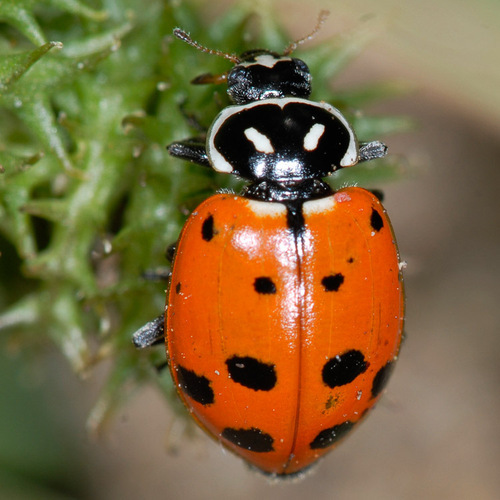
Convergent Lady Beetle
Hippodamia convergens
The ultimate garden ally, the Convergent Lady Beetle is famous for its massive mountain migrations and its distinctive white 'racing stripes.'
Quick Identification
Size
4–8 mm (0.16–0.31 inches) in length; weighing less than 0.05 grams
Colors
Bright orange to deep red wing covers usually adorned with 13 small black spots; black pronotum (neck area) featuring two white diagonal lines and a white border.
Key Features
- Two white diagonal lines on a black pronotum that 'converge' toward the head
- Typically 12 or 13 black spots on orange-red wing covers
- Elongated oval body shape compared to more circular lady beetles
- Small white spots on the front of the head
When You’ll See Them
Geographic range
Where Does the Convergent Lady Beetle Live?
Native to the North American continent, the Convergent Lady Beetle is one of the most widely distributed ladybugs in the region. Its range extends from southern Canada throughout the entire United States and reaches southward through Mexico into parts of Central America. While they are found in almost every state and province, they are particularly iconic in the western United States due to their dramatic montane aggregations.
Basemap © OpenStreetMap contributors
Behavior
The Convergent Lady Beetle is a highly active predator and a favorite among gardeners for its voracious appetite for pests. During the warmer months, these beetles spend their days patrolling vegetation in search of aphid colonies. They are solitary hunters but can be found in high concentrations where food is abundant. When threatened, they exhibit a defense mechanism known as 'reflex bleeding,' where they excrete a foul-smelling, yellow fluid from their leg joints to deter predators like birds or spiders.
One of the most fascinating aspects of their behavior is their migratory and overwintering pattern. In many parts of North America, particularly the western United States, thousands to millions of these beetles migrate from valley floors to mountain peaks as summer temperatures rise. They gather in massive, crawling clusters on rocks and logs to enter a period of dormancy (diapause) through the winter, protected by the snowpack, before returning to the valleys in the spring to lay eggs.
EverydayEarth exclusive
Camera Tips
To capture the Convergent Lady Beetle on camera, you need to think small and focus on macro capabilities. Because these beetles are only a few millimeters long, a standard trail camera may struggle to trigger or focus. For best results, use a dedicated macro lens or an AI-powered backyard camera with a close-focusing distance (under 10 inches). Position your camera near 'sentinel plants' that are prone to aphids, such as milkweed, roses, elderberry, or dill. These are the beetle's primary hunting grounds.
Lighting is crucial for bringing out the vibrant orange and black details. Choose a spot that receives bright, filtered sunlight; direct, harsh midday sun can create distracting glares on their shiny wing covers (elytra). If your camera allows for manual settings, use a fast shutter speed to freeze their movement, as they are surprisingly quick when foraging. If you are using a camera with AI identification, ensure the lens is clean, as small specks of dirt can be larger than the insect itself in a macro frame.
Attracting them to a specific 'stage' for your camera is easiest during the spring and early summer. Planting nectar-rich flowers with flat tops, such as yarrow or fennel, provides a perfect platform for the beetles to land and rest, making them easier to photograph than when they are buried deep in foliage. Avoid using broad-spectrum insecticides in your yard, as these will eliminate both the beetles and their food source, leaving your camera with nothing to see.
Similar Species
Species that look similar or are commonly confused with Convergent Lady Beetle.
Frequently Asked Questions
Record Convergent Lady Beetle at your habitat
Connect a camera to start building your own species record — AI identifies every visitor automatically.