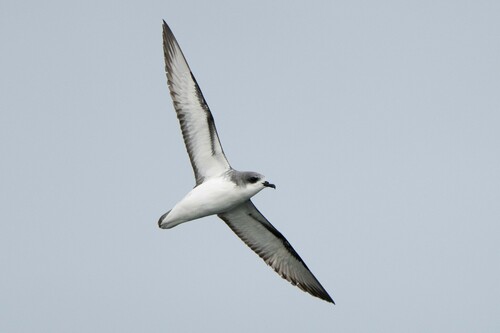
Cook's Petrel
Pterodroma cookii
A master of the Pacific winds, Cook's Petrel journeys from the deep ocean to the high forests of New Zealand. This elusive tītī is a rare marvel of migration and nocturnal mystery.
Quick Identification
Size
Length 25-30 cm (10-12 in), wingspan 65-72 cm (26-28 in), weight 170-210 g (6-7 oz)
Colors
Pale grey upperparts with a dark 'M' pattern; white underparts and forehead; bluish-grey legs and feet
Key Features
- Distinct dark 'M' pattern across grey wings
- Pure white underwings with narrow black margins
- Bluish-grey legs and feet (blue-footed)
- Erratic, high-speed 'bounding' flight
- Small, petite head and bill compared to other petrels
When You’ll See Them
Geographic range
Where Does the Cook's Petrel Live?
This globe-trotting seabird is native to the South Pacific, breeding exclusively on a few select islands in New Zealand, including Little Barrier, Great Barrier, and Codfish Island. During the Southern Hemisphere's winter, they embark on a massive migration to the North Pacific, where they can be found in the deep waters off the coasts of California, Mexico, and even as far as Japan. They are true ocean wanderers that only touch terra firma to raise the next generation.
Basemap © OpenStreetMap contributors
Behavior
Cook's Petrels are high-performance aerialists, often referred to as 'gadfly petrels' because of their rapid, erratic flight patterns. They spend the vast majority of their lives on the open ocean, far from the sight of land, where they are masters of the wind and waves. They are highly migratory, crossing the entire Pacific Ocean twice a year in an incredible display of endurance.
When they return to land to breed, their behavior shifts dramatically. To avoid predators like gulls and hawks, they are strictly nocturnal on land, only approaching their nesting colonies after total darkness has fallen. On the ground, they are somewhat awkward, using their hooked bills and wings to scramble through the forest undergrowth toward their underground burrows. They are incredibly vocal at night, filling the forest canopy with a chorus of 'kek-kek-kek' calls as they communicate with mates.
EverydayEarth exclusive
Camera Tips
Capturing a Cook's Petrel on a trail camera is a unique challenge because they are strictly nocturnal on land. If you are operating near a known breeding colony in New Zealand, position your camera near the entrances of active burrows on forested ridges. Place the camera low to the ground—about 20 cm (8 inches) high—and angle it slightly upward to capture the birds as they land or depart. Use a 'no-glow' infrared flash to avoid disturbing their night vision, as they are extremely sensitive to light.
Since these birds do not visit feeders, camera placement is everything. Look for 'take-off' spots—clearings or high rocks where the birds climb to gain enough wind for flight—or well-trodden paths through the leaf litter. Setting your camera to 'Burst Mode' is highly recommended, as their movements can be very quick and jittery when they are vulnerable on the ground.
The best time for filming is between November and March during the peak of the breeding season. Be aware that the environments they nest in are often damp and cool, so ensure your camera housing is waterproof and the batteries are fresh, as cold temperatures can drain power quickly. Always maintain a respectful distance from the burrow entrance to ensure the birds do not feel threatened.
Similar Species
Species that look similar or are commonly confused with Cook's Petrel.
Frequently Asked Questions
Record Cook's Petrel at your habitat
Connect a camera to start building your own species record — AI identifies every visitor automatically.