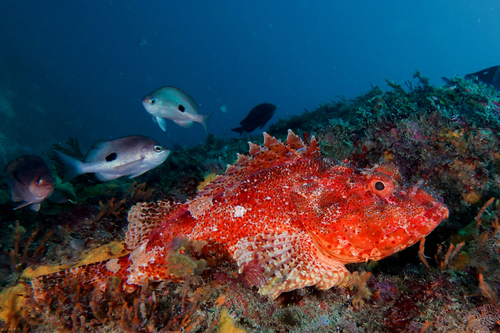
Cook's Scorpionfish
Scorpaena cardinalis
The Cook's Scorpionfish is the South Pacific's most colorful master of disguise, blending perfectly into rocky reefs while sporting a vibrant crimson coat. A formidable ambush predator, it sits in patient silence, waiting for the perfect moment to strike.
Quick Identification
Size
20–45 cm (8–18 in) in length; weights typically up to 1.5 kg (3.3 lbs)
Colors
Brilliant cardinal red to mottled orange-brown with white or dark blotches; belly is usually a paler pink or white
Key Features
- Large bony head with numerous spines and skin flaps
- Bright red or mottled camouflage coloration
- Thick, venomous dorsal spines
- Large, upward-tilted eyes and cavernous mouth
When You’ll See Them
Geographic range
Where Does the Cook's Scorpionfish Live?
Where Does the Cook's Scorpionfish Live? This marine species is native to the temperate and subtropical waters of the Southwestern Pacific Ocean. Its core range spans the eastern coast of Australia, particularly from southern Queensland down through New South Wales, and encompasses the coastal waters around the North Island of New Zealand. It is also a prominent resident of several isolated island territories, including the Kermadec Islands, Lord Howe Island, and Norfolk Island.
Basemap © OpenStreetMap contributors
Behavior
While they appear docile or sluggish, these fish are capable of lightning-fast movements when a meal swims within range. They utilize a powerful suction-feeding method, expanding their massive jaws to create a vacuum that pulls prey into their mouths in milliseconds. They are solitary and territorial, rarely interacting with others of their species except during spawning events.
Interaction with humans is generally passive, as the fish relies on its camouflage to stay hidden. However, they possess highly effective venomous spines along their dorsal, anal, and pelvic fins. These are purely defensive and can deliver an agonizing sting to any diver or wader who accidentally touches or steps on them, making them a species to be admired from a respectful distance.
EverydayEarth exclusive
Camera Tips
Because they are masters of camouflage, use the highest resolution video settings available. To the naked eye, they often look like just another mossy rock, but 4K video will allow you to see the subtle movement of their gills or the occasional blink of an eye. Set your trigger sensitivity to high, but be prepared for 'false' triggers from swaying seaweed. If your camera allows for it, a time-lapse mode set to one frame every 30 seconds is often more effective than motion sensing for these stationary ambush hunters.
Lighting is a critical factor for this species. At depths below 5 meters, the red spectrum of light is absorbed by the water, making this bright red fish look dull or grey. Use a dedicated underwater video light with a wide beam to bring out the brilliant 'cardinal' red of their skin. If you are in shallow water during a sunny day, a red filter on your lens can help restore the natural colors without the need for artificial lights, which might spook the fish or attract unwanted swarms of tiny plankton.
For the best shots, try placing a small amount of 'chum' or a perforated container with crushed shellfish about a meter in front of the lens. The scorpionfish won't eat the bait directly, but it will be attracted to the small fish and crabs that gather to feed on it. This creates a natural hunting scene. Ensure your camera is angled slightly upward to capture the fish's impressive silhouette and the underside of its spiny dorsal fin against the lighter water above.
Frequently Asked Questions
Record Cook's Scorpionfish at your habitat
Connect a camera to start building your own species record — AI identifies every visitor automatically.