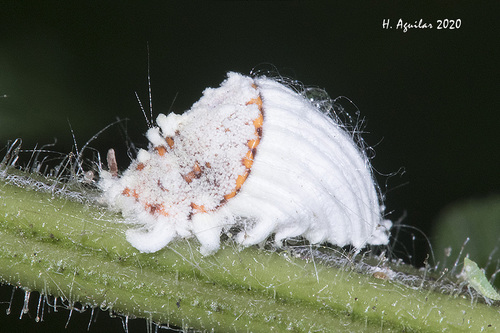
Cottony cushion scale
Icerya purchasi
The cottony cushion scale is a master of waxy architecture, creating elaborate fluted egg sacs that look like miniature pieces of art. Though a notorious pest for citrus growers, it remains a fascinating example of insect engineering and biological history.
Quick Identification
Size
Adult females are 5-7 mm (0.2-0.3 in), but their white egg sacs can double their length to 15 mm (0.6 in).
Colors
Bright orange-red or reddish-brown body, covered in white or yellowish wax, with a prominent snowy-white egg sac.
Key Features
- Large, snowy-white fluted egg sac with longitudinal ridges
- Bright orange-red body visible at the front of the sac
- Six dark legs and long black antennae
- Sticky honeydew residue on nearby leaves
When You’ll See Them
Geographic range
Where Does the Cottony cushion scale Live?
Originally native to the Australian continent, the cottony cushion scale has spread across the globe primarily through the trade of citrus and ornamental plants. It is now a resident in almost every subtropical and temperate region, with significant established populations throughout the Mediterranean, South Africa, and the Americas. In the United States, it is most frequently encountered in the citrus-growing regions of California and Florida, as well as along the Gulf Coast.
Basemap © OpenStreetMap contributors
Behavior
The cottony cushion scale is a sedentary sap-sucker that spends most of its adult life attached to a host plant. While the tiny 'crawlers' (nymphs) are mobile and can be dispersed by wind or animals, the mature hermaphroditic females settle on a branch or leaf midrib to feed and produce their iconic waxy egg sacs. These sacs can contain hundreds of bright red eggs, which the female carries until they hatch.
These insects are famous for their symbiotic relationship with ants. As the scale consumes plant sap, it excretes 'honeydew,' a sugary waste product. Ants frequently 'farm' the scale, protecting them from predators in exchange for this sweet treat. However, the excess honeydew often leads to the growth of black sooty mold, which can cover the host plant's leaves and inhibit photosynthesis.
Historically, this species is significant for being the first major success in biological pest control. In the late 1800s, the California citrus industry was nearly destroyed by this insect until the Vedalia beetle was introduced from Australia to hunt them. Today, they are usually kept in check by these natural enemies rather than chemical pesticides.
EverydayEarth exclusive
Camera Tips
Capturing the cottony cushion scale on camera requires a different approach than fast-moving wildlife. Because they are small and mostly stationary, standard motion-triggered trail cameras will struggle to detect them. Instead, utilize a camera with macro capabilities or a high-resolution sensor that allows for significant digital zooming. Focus your lens on the undersides of leaves or along the green stems of citrus and pittosporum trees, where the white egg sacs stand out most clearly.
Set your camera to time-lapse mode rather than motion trigger. Taking a photo every 10 to 20 minutes can reveal a hidden world of activity. Over several days, you can document the growth of the waxy ovisac or capture the arrival of 'crawlers' as they emerge. This method also increases your chances of filming the dramatic arrival of the Vedalia beetle, a ladybug relative that is a specialized predator of this scale.
Lighting is your biggest challenge. The brilliant white wax of the egg sac is highly reflective and can easily 'blow out' or lose detail in direct sunlight. Position your camera in a spot that receives dappled light or morning sun. If you are using an AI-powered camera with a built-in flash, you may need to soften the light with a piece of translucent tape over the LED to avoid overexposing the white ridges of the insect.
To find the best placement, follow the ants. If you see a steady stream of ants moving up a tree trunk, they are likely headed toward a colony of scale insects to collect honeydew. Placing your camera at the 'destination' of an ant trail is the most reliable way to locate a healthy population of cottony cushion scale for observation.
Similar Species
Species that look similar or are commonly confused with Cottony cushion scale.
Frequently Asked Questions
Record Cottony cushion scale at your habitat
Connect a camera to start building your own species record — AI identifies every visitor automatically.