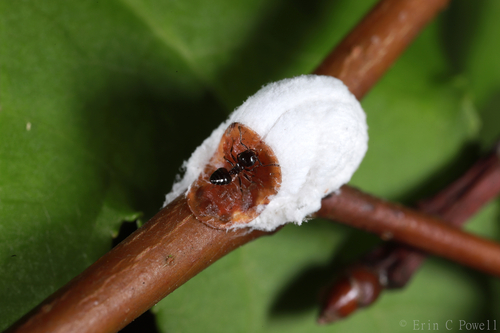
Cottony Maple Scale
Neopulvinaria innumerabilis
Look closely at your maple trees in early summer, and you might see what looks like bits of popcorn stuck to the twigs. These are the egg sacs of the Cottony Maple Scale, a tiny insect that creates a massive waxy home for its offspring.
Quick Identification
Size
Adult females are 3–6 mm (1/8 to 1/4 inch), while the white egg sacs can reach 6–10 mm (1/4 to 3/8 inch)
Colors
Brown or tan oval bodies; distinctive bright white, waxy egg sacs that look like cotton or popcorn
Key Features
- Flat, brown oval-shaped scales on twigs
- Large, white 'cottony' egg sacs protruding from the rear
- Sticky honeydew residue on leaves and surfaces below
- Commonly found on the undersides of silver maple branches
When You’ll See Them
Geographic range
Where Does the Cottony Maple Scale Live?
Native to North America, the Cottony Maple Scale is widespread across the United States and Southern Canada. It is most commonly encountered in the Midwest and Northeastern regions where its preferred host, the silver maple, is a staple of both natural forests and suburban landscaping. While its core population remains in temperate North America, the species has been documented in various pockets across the continent wherever suitable host trees are planted.
Basemap © OpenStreetMap contributors
Behavior
Cottony Maple Scales are fascinating, mostly stationary insects that spend the majority of their life cycle attached to the twigs and branches of host trees. While the adult females are relatively inconspicuous brown discs for much of the year, they become highly visible in late spring and early summer when they produce large, waxy, white egg sacs. These sacs can contain thousands of eggs and are so voluminous that they often cause the female's body to tilt upward, giving the branch a 'snowy' or popcorn-covered appearance.
These insects are 'phloem feeders,' meaning they use specialized mouthparts to suck sap directly from the tree's vascular system. Because they consume more sugar than they can process, they excrete a sticky substance called honeydew. This honeydew often attracts large numbers of ants, which protect the scales from predators in a symbiotic relationship. In the mid-summer, tiny mobile nymphs called 'crawlers' emerge and migrate to the leaves to feed before returning to the twigs to overwinter.
EverydayEarth exclusive
Camera Tips
Capturing the Cottony Maple Scale on camera requires a focus on macro details rather than movement. Because these insects are stationary, your AI camera or trail cam should be positioned very close to a low-hanging branch, specifically targeting the undersides of twigs where the white ovisacs are most prominent. Use a macro lens or a camera with a short focal distance to ensure the 'cotton' texture is sharp and clear. If your camera has a time-lapse feature, this is the perfect species to document; a photo every hour over several weeks in June can show the dramatic growth of the egg sacs.
To make your footage more dynamic, focus on the 'visitors' the scales attract. The sticky honeydew produced by the scales is a magnet for other backyard wildlife. Position your camera to capture the interactions between the scales and the ants that 'milk' them. You may also spot predatory ladybugs or tiny parasitic wasps that come to lay eggs inside the scales. These interactions are much more likely to trigger a motion-sensitive camera than the scales themselves.
Lighting is the biggest challenge when photographing Cottony Maple Scale. The bright white egg sacs can easily become 'blown out' or overexposed in direct sunlight, losing all their structural detail. Try to set up your camera in a spot that receives dappled sunlight or use a small diffuser to soften the light. Early morning or late afternoon light often provides the best contrast, highlighting the brown body of the female against the brilliant white of the wax.
Finally, consider the seasonal timing. The best window for photography is late May through early July. Before this, the scales are small and brown, blending perfectly with the bark. After July, the egg sacs begin to weather and turn gray, and the crawlers migrate to the leaves where they are much harder to spot. If you find a heavily infested branch, keep the camera in that same spot for the entire season to capture the full life cycle from ovisac formation to the emergence of the next generation.
Similar Species
Species that look similar or are commonly confused with Cottony Maple Scale.
Cottony Camellia Scale
Smaller and typically found on the undersides of leaves of evergreen shrubs like camellias and hollies rather than maple twigs.
Magnolia Scale
Much larger (up to 1/2 inch) and lacks the distinct elongated 'cotton' tail; it appears more like a smooth, waxy bump on magnolia branches.
Frequently Asked Questions
Record Cottony Maple Scale at your habitat
Connect a camera to start building your own species record — AI identifies every visitor automatically.