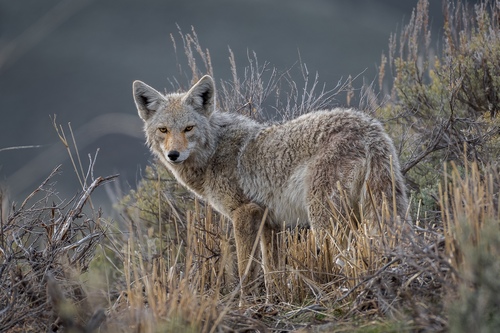
Coyote
Canis latrans
The ultimate survivor of the American wilderness, the coyote is a master of adaptation. From desert canyons to suburban streets, this intelligent 'song dog' is a fascinating neighbor for any backyard explorer.
Quick Identification
Size
Length: 100–135 cm (3.3–4.4 ft); Weight: 7–21 kg (15–46 lb); Shoulder height: 58–66 cm (23–26 in)
Colors
Grizzled gray or reddish-gray coat with a white throat and belly. Reddish-tinted ears and muzzle, with a bushy tail that often features a black tip.
Key Features
- Pointed, upright ears and a slender, fox-like muzzle
- Bushy tail held downward between the hind legs when running
- Bright yellow or amber eyes
- Lanky build with long, thin legs compared to a wolf
When You’ll See Them
Sightings on EverydayEarth
Apr 26, 2026
A pack of at least five coyotes moves through the wooded clearing during the night. Several individuals trot across the leaf-covered ground, while one passes very close to the camera, and others are visible in the background with their eyes reflecting the infrared light.
Mar 1, 2026
A single Coyote enters the frame from the right at night, walking across a snow-covered clearing. It pauses briefly, looking toward the camera with visible eyeshine, before trotting out of the frame to the left.
Feb 24, 2026
A coyote enters the frame from the right, walking across the snowy ground. It pauses to look directly at the camera with bright eyeshine. Suddenly, it bolts to the left, and a white-tailed deer is seen running in the same direction across the background immediately afterward, with its tail raised in a 'flagging' posture.
Jun 28, 2026
Two coyotes trot across the grassy clearing from right to left, moving purposefully through the darkness.
May 27, 2026
A coyote moves across the clearing under the cover of night. It pauses briefly to look directly toward the camera, with its eyes reflecting the infrared light, before continuing its path into the surrounding woods.
Apr 26, 2026
A coyote is captured trotting across the grassy ridge of the clearing, moving quickly from left to right before exiting the frame.
Geographic range
Where Does the Coyote Live?
The coyote is native to North America, with a range that has expanded dramatically over the last century due to the removal of larger competitors. They are now found across the entire continent, from the tundra of northern Alaska and across all Canadian provinces down through the contiguous United States. Their reach extends through Mexico and into Central America, with established populations now found as far south as Panama.
Basemap © OpenStreetMap contributors
Recorded on EverydayEarth
Behavior
Coyotes are highly intelligent and opportunistic mammals known for their incredible adaptability. While they are often associated with the wide-open plains of the West, they have successfully moved into every corner of the continent, including the hearts of major cities. They are social animals that typically live in family units centered around a breeding pair, though they frequently hunt alone or in loose pairs. Their complex social structure is maintained through a wide range of vocalizations, including the iconic high-pitched howls and yips that earned them the nickname 'song dog.'
In human-dominated landscapes, coyotes often become more nocturnal to avoid interaction, though they are naturally crepuscular. They are extremely wary and possess keen senses of smell and hearing, making them difficult to spot in person. Despite their reputation as pests, they play a vital role in the ecosystem by controlling rodent and rabbit populations and acting as a 'buffer' species that prevents smaller predators like raccoons and foxes from overpopulating.
EverydayEarth exclusive
Camera Tips
To capture high-quality footage of a coyote, placement is everything. These animals are creatures of habit and will often use 'wildlife highways' such as fence lines, dry creek beds, or the edges where a mowed lawn meets dense brush. Set your camera at 'coyote eye level'—roughly 18 to 24 inches off the ground—to get a full-body profile rather than a top-down view. Because they are naturally suspicious of new objects, try to camouflage your camera using natural debris or mounting it to a weathered post.
Coyotes have incredible vision and can be spooked by the 'red glow' emitted by standard infrared trail cameras. For the best results, use a 'No Glow' or 'Black Flash' (940nm) camera. This ensures the animal remains calm and exhibits natural behaviors rather than staring into the lens or running away. Set your camera to a high-speed 'Burst Mode' to capture 3 to 5 photos per trigger, as coyotes often move at a steady trot that can result in blurred images on slower settings.
While we never recommend feeding coyotes, you can encourage them to pause in front of your camera using non-food lures. A small amount of gland-based scent or even a splash of fish oil on a log can trigger their curiosity. During the winter months, coyotes are more active during the day as they search for mates, making January and February the best time to capture rare daylight footage. In the summer, look for 'pup' activity in the early evening hours as the year's litter begins to explore their territory.
Similar Species
Species that look similar or are commonly confused with Coyote.
Gray Wolf
Much larger (up to 100 lbs) with a blockier snout, shorter ears, and a tail held higher when running.
Red Fox
Smaller with distinctive black 'socks' on its legs and a tail that always ends in a white tip.
Domestic Dog
Varies by breed, but dogs usually have a more curved tail, floppier ears, and lack the grizzled 'agouti' fur pattern of a coyote.
Frequently Asked Questions
Record Coyote at your habitat
Connect a camera to start building your own species record — AI identifies every visitor automatically.