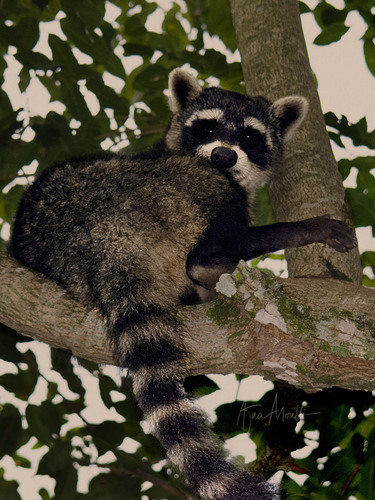
Crab-eating Raccoon
Procyon cancrivorus
The Crab-eating Raccoon is the sleek, water-loving specialist of the South American night. With its sensitive paws and iconic mask, this intelligent mammal is a master of the marshlands.
Quick Identification
Size
Head-body length: 45–90 cm (18–35 in); Tail length: 20–56 cm (8–22 in); Weight: 2–12 kg (4.4–26.5 lbs)
Colors
Grizzled grey-brown fur with a black mask; tail is ringed with 6-8 dark bands; legs are typically darker or sootier than its northern relatives
Key Features
- Distinctive black facial mask
- Ringed bushy tail
- Slender, dark-colored legs and feet
- Pointed snout with sensitive whiskers
When You’ll See Them
Geographic range
Where Does the Crab-eating Raccoon Live?
The Crab-eating Raccoon is native to the tropical and subtropical regions of Central and South America. Its range begins in Costa Rica and Panama, stretching southward across the vast majority of South America east of the Andes. It is widely distributed across the Amazon basin and can be found as far south as northern Argentina, Uruguay, and southern Brazil, making it one of the most widespread medium-sized carnivores on the continent.
Basemap © OpenStreetMap contributors
Behavior
Crab-eating Raccoons are primarily nocturnal, solitary foragers that spend much of their lives near water. Unlike their northern cousins, they are somewhat more adapted to terrestrial life on forest floors and marshlands, though they remain agile climbers and strong swimmers. They are highly intelligent and possess incredibly sensitive front paws, which they use to 'see' their environment through touch, often feeling for prey under rocks or in murky water without looking at what they are doing.
While generally shy and elusive around humans, these raccoons are opportunistic and can adapt to disturbed habitats or suburban edges where food is plentiful. They communicate through a series of chitters, whistles, and growls, and they use communal latrines to mark territory and share social information. During the day, they retreat to hollow trees, rock crevices, or dense vegetation to sleep, emerging shortly after dusk to begin their nightly patrol for food.
EverydayEarth exclusive
Camera Tips
To successfully capture the Crab-eating Raccoon on your AI-powered camera, focus your efforts on 'wetland highways.' These animals almost always travel along the edges of water. Look for muddy banks, stream crossings, or drainage ditches where you can see their characteristic hand-like tracks. Mount your camera low—about 30 to 45 centimeters (12 to 18 inches) off the ground—and angle it slightly downward. This positioning is perfect for catching their unique foraging behavior, as they spend a lot of time with their heads down, feeling for food in the mud.
Because they are strictly nocturnal, the quality of your camera's infrared (IR) flash is critical. Use a 'No-Glow' or 'Black IR' setting if available, as these raccoons can be skittish around visible red glows. If you are placing a camera in a backyard, position it near a water feature or along a fence line that has dense cover nearby. They prefer to stay under the shadows rather than crossing open lawns.
Scent is the most powerful lure for this species. You don't need expensive lures; a can of oily sardines or dry cat food placed in a perforated container will keep them interested and in front of the lens for several minutes. Just be sure to secure the bait so they don't carry it off immediately! During the rainy season, activity levels usually spike, so ensure your batteries are fresh and your memory card has plenty of space for video clips, which provide much better identification data than still photos.
Similar Species
Species that look similar or are commonly confused with Crab-eating Raccoon.
Frequently Asked Questions
Record Crab-eating Raccoon at your habitat
Connect a camera to start building your own species record — AI identifies every visitor automatically.