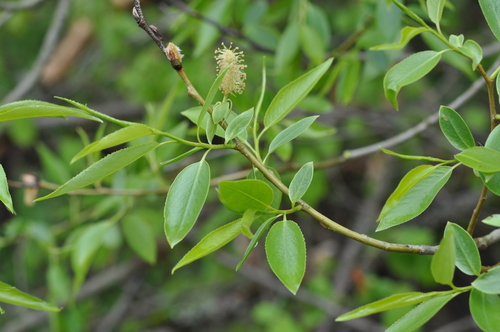
crack willow
Salix euxina
The Eastern Crack Willow is a shimmering riparian giant, famous for its 'snapping' branches and its ability to thrive in the wettest soils. A vital stabilizer of riverbanks, it creates lush, green corridors that support a massive variety of backyard wildlife.
Quick Identification
Size
A medium to large tree reaching heights of 10–20 meters (33–65 feet) with a canopy spread often matching its height.
Colors
Glossy dark green upper leaves with pale underside; grey-brown furrowed bark; yellowish-green catkins.
Key Features
- Brittle twigs that snap cleanly at the base with an audible 'crack'
- Long, lance-shaped leaves with finely serrated edges
- Deeply fissured, corky bark on mature specimens
- Slender, shimmering canopy that moves easily in the wind
When You’ll See Them
Geographic range
Where Does the crack willow Live?
The Eastern Crack Willow is native to the temperate regions of Western Asia and Eastern Europe. Its core range extends across the Caucasus Mountains, reaching through Turkey, Georgia, Armenia, and Azerbaijan into southern parts of Russia. While it remains most prominent in these ancestral lands, it has historically influenced the genetics of willow populations across much of Central Europe through hybridization.
Basemap © OpenStreetMap contributors
Behavior
The Eastern Crack Willow is a vigorous, fast-growing deciduous tree that dominates riparian landscapes. Its most fascinating 'behavior' is its method of asexual reproduction; the tree’s branches are intentionally brittle at the base. During high winds or floods, these twigs snap off and float downstream, where they quickly take root in muddy banks to form new clonal colonies. This strategy allows the species to colonize river systems much faster than through seed dispersal alone.
As a pioneer species, it plays a critical role in the local ecosystem by stabilizing riverbanks with its intensive, water-loving root systems. While it doesn't 'interact' with humans in a social sense, it is a staple of traditional basketry and landscape management. In backyards, it provides significant shade and acts as a massive nutrient pump, though its brittle nature means it frequently drops debris after storms.
EverydayEarth exclusive
Camera Tips
Capturing the Eastern Crack Willow on a trail camera requires a focus on its seasonal transitions. To document the tree's structure, place your camera at a wide-angle 10–15 feet away from the main trunk. Because willows move significantly in the wind, use a 'High' sensitivity setting only if you want to capture the motion of the leaves; otherwise, set a 'Time-Lapse' mode at 30-minute intervals to witness the dramatic 'green-up' during the spring thaw.
For those interested in the wildlife the tree attracts, mount your camera directly onto the trunk facing a sturdy horizontal limb. These limbs are major highways for squirrels and nesting birds. During the early spring flowering period (when catkins appear), position a camera with macro-capabilities or a close focal range near the lower branches to capture the swarm of early-season pollinators that rely on the willow as a primary food source.
Avoid placing cameras on the smaller, brittle outer branches, as the 'crack' willow name is earned—these limbs frequently snap during heavy winds and could result in a lost or damaged camera. Instead, use the thick, furrowed main trunk for stability. If your goal is to capture the tree's interaction with the water, angle your camera toward the base where the roots meet the mud; this is a prime spot for spotting semi-aquatic mammals like minks or beavers that frequent willow groves.
Similar Species
Species that look similar or are commonly confused with crack willow.
Frequently Asked Questions
Record crack willow at your habitat
Connect a camera to start building your own species record — AI identifies every visitor automatically.