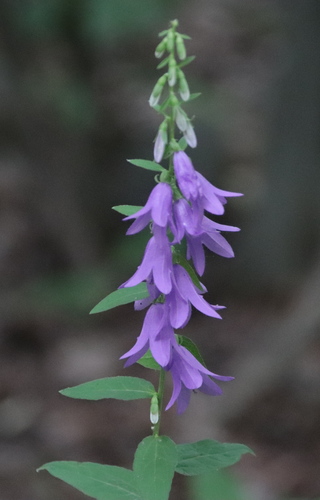
Creeping Bellflower
Campanula rapunculoides
A striking but persistent garden 'rover,' the Creeping Bellflower is famous for its elegant purple spires and its nearly indestructible root system. While a favorite for bees, this Eurasian native is a master of survival in the modern backyard.
Quick Identification
Size
Stems typically reach 30–100 cm (12–39 inches) in height; flowers are 2–3 cm (0.8–1.2 inches) long.
Colors
Deep violet-blue to purple nodding flowers; mid-green foliage; pale white or yellowish thick rhizomatous roots.
Key Features
- Nodding, bell-shaped flowers arranged on one side of the stem
- Heart-shaped basal leaves with long stalks
- Aggressive creeping white rhizomes
- Stems are often unbranched and slightly hairy
- Five-lobed petals that flare outward at the tips
When You’ll See Them
Geographic range
Where Does the Creeping Bellflower Live?
Creeping Bellflower is native to the temperate regions of Europe and Western Asia, where it is a common sight in meadows and woodland clearings. It has since expanded its reach significantly, becoming naturalized and often invasive throughout much of North America, particularly across the northern United States and southern Canada. This hardy traveler thrives in a wide variety of climates, from the cool foothills of the Alps to the humid suburbs of the Midwest, making it one of the most widely distributed members of the Campanula genus.
Basemap © OpenStreetMap contributors
Behavior
Creeping Bellflower is a resilient perennial known primarily for its aggressive growth and beautiful but deceptive floral display. Unlike many garden plants that stay where they are put, this species utilizes an extensive underground network of fleshy rhizomes and small tubers to 'creep' across lawns and garden beds. Once established, it is notoriously difficult to eradicate because even a tiny fragment of root left in the soil can regenerate into a full plant.
In its interaction with the ecosystem, it is a significant nectar source for long-tongued bees, though in North America, it is viewed as a high-impact invasive species. It tends to outcompete native flora by forming dense monocultures, emerging early in the spring to shade out smaller neighbors. While humans often admire its striking purple spires, most gardeners eventually come to view it as a 'thug' due to its ability to choke out prized perennials and even survive under heavy mulch or herbicide application.
EverydayEarth exclusive
Camera Tips
Capturing the Creeping Bellflower on an AI-powered backyard camera offers a unique opportunity to study plant movement and pollinator interaction. To get the best shots, position your camera at a low angle, roughly 12 to 18 inches off the ground, to highlight the 'nodding' nature of the bells. Because the flowers grow unilaterally (all on one side of the stem), ensure your camera is facing the side of the stalk where the bells are opening for the most dramatic color display.
Use a time-lapse setting if your camera supports it. This is the best way to visualize the 'behavior' of the plant, such as the slow unfurling of the purple petals and the way the stem leans toward the sunlight throughout the day. Set your interval to one photo every 15–30 minutes during daylight hours to create a smooth transition video of the blooming process.
If you are using a motion-activated camera, you may find that the swaying of the tall stems in the wind triggers the sensor. While this can result in many 'empty' videos, it provides a great chance to see which insects visit the plant. Place the camera within 2 feet of a healthy cluster to catch high-definition footage of bumblebees and honeybees crawling inside the bells for nectar. Early morning light (6–9 AM) provides the softest illumination, preventing the deep purples from looking 'blown out' or overly dark in high-contrast midday sun.
Similar Species
Species that look similar or are commonly confused with Creeping Bellflower.
Frequently Asked Questions
Record Creeping Bellflower at your habitat
Connect a camera to start building your own species record — AI identifies every visitor automatically.