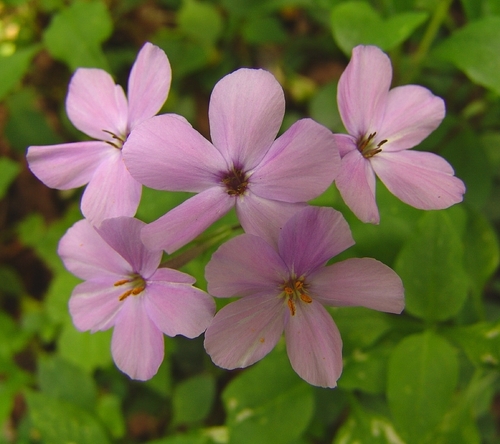
creeping phlox
Phlox stolonifera
A vibrant, low-growing carpet of color that transforms the forest floor into a sea of lavender and blue every spring.
Quick Identification
Size
Stands 15–25 cm (6–10 inches) tall while in bloom, with a creeping spread of 30–60 cm (12–24 inches).
Colors
Clusters of five-petaled flowers in shades of lavender, violet-blue, or pink with a small, darker central eye; foliage is deep green.
Key Features
- Low-growing, mat-forming stoloniferous stems
- Five-petaled flowers with rounded lobes
- Oval to egg-shaped evergreen leaves
- Smooth-edged foliage unlike the needle-like leaves of moss phlox
When You’ll See Them
Geographic range
Where Does the creeping phlox Live?
Native to the North American continent, Creeping Phlox is a signature wildflower of the eastern United States. Its core range follows the rugged beauty of the Appalachian Mountains, stretching from the temperate woodlands of Pennsylvania down through the rolling hills of northern Georgia and Alabama. While it thrives in its southern mountain stronghold, naturalized populations have wandered much further north, and it can now be found carpeting forest floors as far as Québec, Canada, and west toward Ohio.
Basemap © OpenStreetMap contributors
Behavior
Creeping Phlox is a classic woodland perennial that acts as a living carpet in the early spring. Unlike many wildflowers that grow upright to compete for light, this species utilizes 'stolons'—horizontal stems that run along the ground—to colonize new territory. This growth habit allows it to form dense, lush mats that help stabilize soil on slopes and stream banks. In the garden, it is valued as a polite groundcover that suppresses weeds without becoming invasive.
During the peak of spring, the plant undergoes a dramatic transformation, sending up vertical flowering stalks that hover above the foliage. These blooms are a vital early-season resource for pollinators. While the plant is relatively stationary in its movement, it interacts with humans primarily as a beloved ornamental. It is deer-resistant but highly attractive to the 'watchers' of the forest, such as butterflies and clearwing moths, making it a high-traffic zone for backyard wildlife observation.
EverydayEarth exclusive
Camera Tips
Capturing Creeping Phlox requires a different strategy than mobile wildlife. To get the most out of your camera, position it at a 'worm’s eye view.' Mount your camera just 5–8 inches off the ground, angled slightly upward. This perspective captures the height of the flower stalks against the background and makes for a much more dramatic shot than looking straight down at the dirt.
Because the flowers are stationary, the real action comes from the visitors they attract. Use your AI camera's 'small motion' or 'macro' settings if available. Creeping Phlox is a magnet for swallowtail butterflies and the elusive hummingbird moth. To catch these fast-moving visitors, set your trigger interval to the shortest possible time and ensure your shutter speed is high to freeze the motion of beating wings against the still lavender petals.
Early morning or late afternoon light (the 'Golden Hour') is best for Phlox, as midday sun can wash out the delicate purples and blues. If your camera supports time-lapse mode, this is a fantastic species to document. A time-lapse over 7–10 days in mid-April can capture the spectacular transition from green groundcover to a solid blanket of color as the buds open in unison. Ensure the camera is securely staked, as even a small nudge can ruin the continuity of a long-term time-lapse.
Similar Species
Species that look similar or are commonly confused with creeping phlox.
Frequently Asked Questions
Record creeping phlox at your habitat
Connect a camera to start building your own species record — AI identifies every visitor automatically.