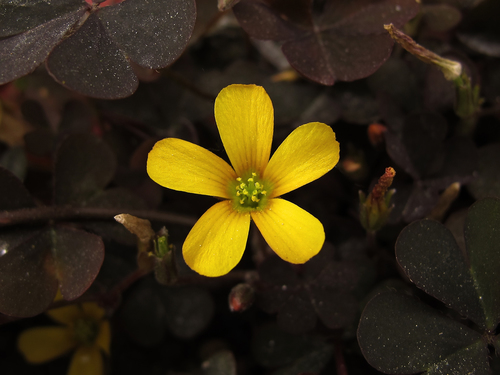
Creeping Woodsorrel
Oxalis corniculata
Often mistaken for clover, the Creeping Woodsorrel is a miniature marvel featuring 'sleeping' leaves and seed pods that explode like tiny cannons.
Quick Identification
Size
Height 5-10 cm (2-4 in); creeping stems can spread 30 cm (12 in) or more
Colors
Bright green to deep burgundy leaves; vibrant yellow five-petaled flowers
Key Features
- Trifoliate heart-shaped leaves
- Small yellow flowers with five petals
- Prostrate stems that root at nodes
- Cylindrical seed capsules that explode when touched
When You’ll See Them
Geographic range
Where Does the Creeping Woodsorrel Live?
Originally native to Southeast Asia, Creeping Woodsorrel has become one of the most successful cosmopolitan plants in the world. It is now naturalized across almost every continent, with significant populations throughout North America, Europe, Africa, and Oceania. This hardy traveler is particularly common in the United States, Japan, and Australia, where it thrives in human-altered landscapes and temperate to subtropical climates.
Basemap © OpenStreetMap contributors
Behavior
Creeping Woodsorrel is a highly adaptable herbaceous plant known for its opportunistic growth and fascinating rhythmic movements. One of its most distinctive behaviors is nictinasty, or "sleep movements," where its leaflets fold downward and close up at night or during stressful weather conditions to protect the plant's delicate surfaces. This movement is a response to light intensity and helps the plant conserve moisture and energy.
The species is also famous for its aggressive dispersal strategy known as ballochory. As its seed pods mature, they build up internal pressure; when touched by a passing animal, a raindrop, or even a heavy gust of wind, the pod bursts open. This explosive action can catapult tiny seeds several meters away from the parent plant, allowing it to colonize new garden beds and sidewalk cracks with remarkable speed. It is a social plant in an ecological sense, often forming dense mats that provide micro-habitats for tiny soil invertebrates.
EverydayEarth exclusive
Camera Tips
To capture the fascinating life of Creeping Woodsorrel, standard motion-triggering won't work; instead, utilize the time-lapse feature on your AI-powered camera. To record the "sleep movements" of the leaves, mount your camera on a low-profile tripod or directly on the ground. Set the interval to take one photo every 5 minutes starting an hour before sunset and continuing until an hour after dusk. When played back, you'll see the heart-shaped leaflets tucking themselves in for the night in a graceful, rhythmic motion.
Because the yellow flowers are small, usually under 10mm wide, a macro lens or a close-focus setting is essential. The flowers are heliotropic, meaning they open in response to bright sunlight and close in the late afternoon or during heavy cloud cover. For the best color saturation, aim to capture the plant between 10 AM and 2 PM on a bright day. If your plant has the dark burgundy leaf mutation (common in many backyards), backlighting it with the low morning sun can make the leaves appear to glow with a deep ruby light.
One of the most exciting challenges is capturing the explosive seed dispersal. This requires high-speed video capabilities. On a dry day, identify a ripe, elongated seed pod—it will look slightly swollen and yellowish-green. Set your camera to its highest frames-per-second (FPS) setting and use a long blade of grass to gently poke the pod. The resulting footage will reveal the incredible speed at which the seeds are launched, a process usually invisible to the naked eye.
Similar Species
Species that look similar or are commonly confused with Creeping Woodsorrel.
Frequently Asked Questions
Record Creeping Woodsorrel at your habitat
Connect a camera to start building your own species record — AI identifies every visitor automatically.