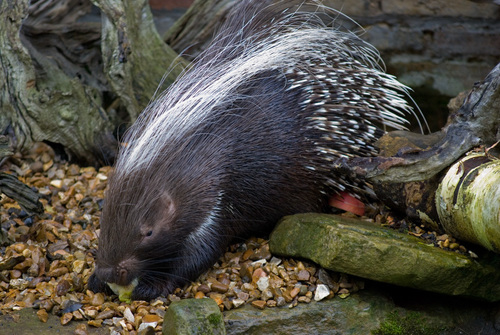
Crested Porcupine
Hystrix cristata
The Crested Porcupine is a nocturnal marvel, draped in a coat of formidable black-and-white quills and a wild white mohawk. As the largest rodent in Europe and Africa, this 'spiny pig' is a master of the night and a thrilling sight for any backyard explorer.
Quick Identification
Size
Body length of 60–83 cm (24–33 in) and weighing between 13–27 kg (29–60 lbs)
Colors
Dark brown or black body hair with striking black-and-white banded quills; white crest of long hairs on the head and neck
Key Features
- Long, stiff quills along the back and sides that can be raised into a fan
- White erectile crest of hair from the forehead to the shoulders
- Short, stumpy tail equipped with hollow 'rattle-quills'
- Large, heavy-set body with short, powerful legs for digging
When You’ll See Them
Geographic range
Where Does the Crested Porcupine Live?
The Crested Porcupine is the only porcupine species native to Europe, where it is widely found across the Italian peninsula and Sicily. Its primary range extends across North Africa and into Sub-Saharan Africa, including countries like Ethiopia, Tanzania, and Nigeria. These resilient rodents are most at home in Mediterranean-style shrublands and open woodlands, but they are increasingly spotted on the fringes of human settlements where food is more abundant.
Basemap © OpenStreetMap contributors
Behavior
Crested Porcupines are primarily nocturnal and highly terrestrial, spending their daylight hours hidden away in complex burrow systems, rock crevices, or abandoned aardvark holes. They are remarkably social within their family units, often living in monogamous pairs that stay together for life. While they appear slow and lumbering, they are surprisingly agile when threatened, often puffing up their quills to double their apparent size and rattling their tail quills to create a chilling warning hiss.
When it comes to defense, the Crested Porcupine is legendary. Contrary to the myth, they cannot 'fire' their quills, but they will charge backward or sideways to embed the sharp, barbed needles into an attacker’s skin. In suburban settings, they are generally shy but can become quite bold if they discover a consistent food source like a vegetable garden or compost bin. They are vocal creatures, communicating through a series of grunts, whines, and the unmistakable clatter of their quills.
EverydayEarth exclusive
Camera Tips
To capture high-quality footage of a Crested Porcupine, place your camera low to the ground—about 30 to 40 centimeters (12-16 inches) high. Because they are strictly nocturnal, a camera with high-quality infrared (IR) LEDs is essential to see their intricate black-and-white quill patterns without startling them with a white flash. Position the camera near known burrow entrances or along well-worn paths through tall grass, as these creatures tend to follow the same 'game trails' every night.
Baiting can be very effective if local regulations allow. They are particularly fond of sweet potatoes, carrots, and fallen fruit like apples or melons. Placing a few large, hard vegetable chunks in front of the camera will encourage the porcupine to linger, giving you a better chance to capture their foraging behavior. Be sure to secure the bait or place it in a spot where the porcupine has to turn sideways to the camera, which provides the best view of their impressive quill fan.
Keep in mind that Crested Porcupines have a very keen sense of smell but relatively poor eyesight. If you are checking your camera, try to minimize leaving your scent behind. Using a fast trigger speed is helpful, as they can move surprisingly quickly when they aren't feeding. In the colder months, they remain active, but you'll see more frequent visits during the warmer dry seasons when they have to travel further for water and succulent roots.
Similar Species
Species that look similar or are commonly confused with Crested Porcupine.
Cape Porcupine
Nearly identical, but the Cape porcupine has a short white stripe along the midline of the rump, whereas the Crested porcupine's rump is mostly black.
North American Porcupine
Much smaller, lacks the long crest, and is an expert climber often found in trees, unlike the ground-dwelling Crested Porcupine.
Frequently Asked Questions
Record Crested Porcupine at your habitat
Connect a camera to start building your own species record — AI identifies every visitor automatically.