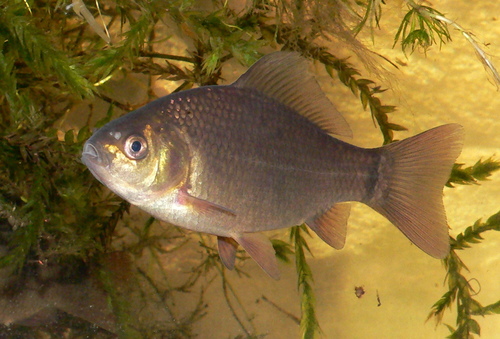
Crucian Carp
Carassius carassius
A master of survival with a shimmering bronze hue, the Crucian Carp is the golden jewel of the still-water pond. Known for its incredible ability to thrive in low-oxygen environments, this resilient fish is a favorite for backyard naturalists.
Quick Identification
Size
15–35 cm (6–14 inches) long; weights typically between 0.5–2 kg (1.1–4.4 lbs)
Colors
Deep golden-bronze or brassy flanks, dark olive-green back, and a pale yellowish-white belly; fins are often dusky with a reddish or orange tint.
Key Features
- Deep, rounded 'high-backed' body profile
- Convex (rounded outward) dorsal fin
- Lack of sensory barbels around the mouth
- Small, tightly packed scales
When You’ll See Them
Geographic range
Where Does the Crucian Carp Live?
The Crucian Carp is native to a broad swathe of the Palearctic, stretching from the United Kingdom across Central and Eastern Europe all the way to the Kolyma River drainage in Siberia. While they are a signature species of Northern European lowland ponds, their range has become fragmented in the west due to habitat loss and the introduction of competing species. They are particularly associated with 'ghost ponds' and farm ponds across England, Germany, and Scandinavia, where their ability to survive harsh winters allows them to persist in isolated environments.
Basemap © OpenStreetMap contributors
Behavior
Crucian Carp are legendary for their hardiness, possessing a unique physiological ability to survive for months in frozen or stagnant ponds with virtually no oxygen. They achieve this by switching to a form of anaerobic metabolism, essentially producing alcohol within their bodies to keep their cells functioning. They are generally shy, cautious fish that prefer to stay hidden within dense submerged vegetation rather than swimming in open water.
In the presence of predatory fish like Pike or Perch, Crucian Carp exhibit a fascinating defense mechanism: they can actually change their body shape over time, growing a much deeper, more circular profile that makes them physically difficult for a predator to swallow. They are social creatures that move in small shoals, particularly when young, and are most active during the low-light hours of dawn and dusk.
EverydayEarth exclusive
Camera Tips
Capturing the golden shimmer of a Crucian Carp requires a specialized approach since they rarely break the surface. If you are using a trail camera, position it on a high bank or an overhanging branch looking straight down into a clear, shallow margin of a pond. Use a polarizing filter over the lens to cut through water surface glare; without this, you will likely only see reflections of trees or sky instead of the fish below.
For a truly immersive view, underwater 'action' cameras or dedicated pond cameras are the best choice. Place the camera 20-40cm deep, nestled near the edge of lily pads or reed beds, which are the Crucian’s preferred foraging grounds. Baiting a small area with a handful of organic pellets or breadcrumbs can encourage them to linger in front of the lens, but be patient—they are easily spooked by sudden movements or shadows.
Nighttime filming can be very productive as these fish become bolder in the dark. Use 'no-glow' 940nm infrared cameras to avoid scaring the fish with visible red lights. Ensure your camera is set to a high frame rate (at least 30fps) to capture their subtle movements as they sift through the substrate. During the spawning season in late spring, focus your cameras on thick aquatic weeds where the fish will be at their most active and visible.
Similar Species
Species that look similar or are commonly confused with Crucian Carp.
Frequently Asked Questions
Record Crucian Carp at your habitat
Connect a camera to start building your own species record — AI identifies every visitor automatically.