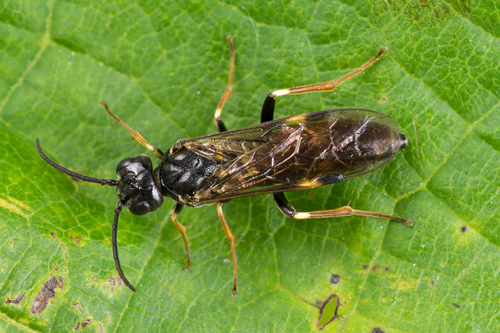
Curled Rose Sawfly
Allantus cinctus
A master of garden mimicry, the Curled Rose Sawfly is famous for its larvae that rest in perfect spirals beneath rose leaves. While their feeding may worry gardeners, these stingless flyers are a fascinating part of the backyard ecosystem.
Quick Identification
Size
Adults are 7-10 mm (0.27-0.4 in) long; larvae reach 15-20 mm (0.6-0.8 in)
Colors
Adults are black with a prominent white band on the fifth abdominal segment (females); larvae are dark green with numerous tiny white spots and a yellowish-brown head
Key Features
- Black body with a single bold white band around the abdomen
- Larvae rest in a distinctive tight spiral on the underside of leaves
- Two pairs of transparent, smoky-tinged wings
- Larvae have a 'granular' skin texture due to small white bumps
- Slow, hovering flight pattern near rose bushes
When You’ll See Them
Geographic range
Where Does the Curled Rose Sawfly Live?
Native to Europe, the Curled Rose Sawfly is a widespread resident across the continent, from the United Kingdom and Scandinavia down to the Mediterranean and eastward into Russia. It has also been successfully introduced to North America, where it is now a common inhabitant of gardens throughout the United States and Southern Canada. The species thrives wherever ornamental or wild roses are found in temperate climates.
Basemap © OpenStreetMap contributors
Behavior
The Curled Rose Sawfly is best known for its larval stage, which is a common sight in gardens where roses are cultivated. These larvae are famous for their defensive posture; when not feeding or when they feel threatened, they curl their bodies into a tight, snail-like spiral on the underside of a leaf. This behavior helps them blend into the shadows and may discourage predators by mimicking an unpalatable object or simply making them harder to grip.
As adults, these insects are solitary and lack the stingers associated with true wasps, making them completely harmless to humans and pets. They are most active on warm, still days when females can be seen searching for suitable rose stems. Using a saw-like organ at the end of their abdomen, they cut small slits into the plant tissue to deposit their eggs. Unlike social insects, they provide no parental care once the eggs are laid.
EverydayEarth exclusive
Camera Tips
To capture high-quality images of the Curled Rose Sawfly, you should position your camera extremely close to rose foliage, as these insects are small and often stay tucked away. Focus your lens on the undersides of leaves where you notice 'skeletonized' damage or circular holes, as this is where the larvae spend the majority of their time. Because the larvae are small, a macro lens or a camera with a very short minimum focal distance is required for clear identification.
For the adult sawflies, target the stems of new rose growth during the sunniest part of the day. The females are often seen hovering slowly around the canes looking for egg-laying sites. Set your camera's shutter speed to at least 1/500th of a second if you want to freeze the motion of their transparent wings. Using a tripod is highly recommended to maintain focus on a specific leaf or stem, as even a light breeze can move the plant out of the frame.
Seasonal timing is critical for this species. In many regions, there are two generations per year—one in late spring and another in mid-summer. Monitor your roses for the first signs of leaf damage in May; this is the best time to deploy your camera. If your device has an AI-triggering system, ensure it is set to the highest sensitivity for 'small insects' to ensure it picks up the slow, deliberate movements of the larvae.
Similar Species
Species that look similar or are commonly confused with Curled Rose Sawfly.
Frequently Asked Questions
Record Curled Rose Sawfly at your habitat
Connect a camera to start building your own species record — AI identifies every visitor automatically.