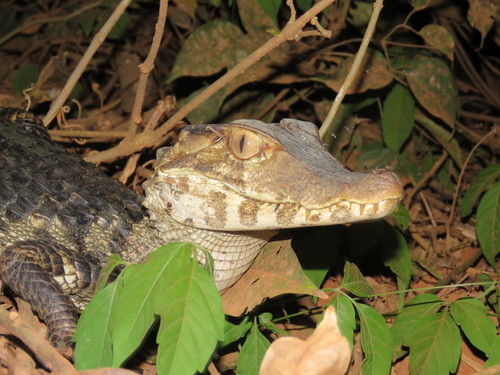
Cuvier's Dwarf Caiman
Paleosuchus palpebrosus
Meet the world's smallest crocodilian, a heavily armored master of the Amazonian undergrowth. Known for its smooth forehead and incredible cold tolerance, this elusive reptile brings the prehistoric wild to your backyard lens.
Quick Identification
Size
Total length of 1.2–1.5 meters (4–5 feet) and weighing between 6–7 kg (13–15 lbs)
Colors
Dark brownish-black with reddish-brown highlights; duller gray or brown bellies; juveniles exhibit light brown or yellow banding
Key Features
- Smooth, high forehead without a bony ridge between the eyes
- Heavily armored back and belly with thick bony plates
- Short, blunt snout with an upturned tip
- Reddish-brown iris in the eyes
When You’ll See Them
Geographic range
Where Does the Cuvier's Dwarf Caiman Live?
Cuvier's Dwarf Caiman is a native resident of the northern and central regions of South America. Its core range encompasses the massive Amazon and Orinoco basins, stretching across Brazil, Colombia, Peru, Venezuela, and the Guianas, reaching as far south as northern Paraguay. These small crocodilians are masters of the tropical interior, favoring the secluded, fast-moving waterways of the rainforest over open marshlands.
Basemap © OpenStreetMap contributors
Behavior
Cuvier's Dwarf Caiman is a secretive and primarily nocturnal reptile that spends much of its time in the shadows of riverine forests. Unlike larger crocodilians that spend hours basking in open sun, this species prefers the cooler, shaded environments of fast-flowing streams and flooded forest floors. They are surprisingly terrestrial for a crocodilian, often traveling long distances over land to find new water sources or to hunt in the undergrowth during the rainy season.
These caimans are solitary by nature and are remarkably cold-tolerant, a trait that allows them to inhabit high-altitude streams or cooler forest interiors where other caimans cannot survive. While they are generally shy and will retreat into the water or their burrows when approached by humans, they are efficient, patient predators that use their small size and dark coloration to blend perfectly into the leaf litter and murky water.
EverydayEarth exclusive
Camera Tips
Capturing the world's smallest crocodilian on camera requires a strategy focused on their nocturnal and semi-terrestrial habits. Place your camera along the muddy banks of small, forested streams, specifically looking for 'haul-out' spots where the mud is smoothed or vegetation is flattened. Because these reptiles sit very low to the ground, your camera should be mounted no higher than 12 inches (30 cm) and angled slightly downward to ensure you capture their entire profile rather than just the top of their head.
Night vision is essential, as Cuvier's Dwarf Caiman is almost exclusively active after dark. Look for cameras with 'no-glow' infrared flashes to avoid startling them, as they are more sensitive to light than larger caimans. If you are setting up near a backyard pond or a slow-moving creek, try to position the camera so it covers both a section of the water and a portion of the bank; they often sit motionless at the water's edge waiting for prey to pass by.
To increase your chances of a sighting, you can use scent lures such as oily fish or raw meat secured in a mesh bag near the camera's trigger zone. However, be prepared for other nocturnal visitors like opossums or raccoons. Set your camera to take short video clips (15–30 seconds) rather than just photos, as this will help you see their unique swimming motion and the way they use their blunt snouts to forage in the mud. During the wet season, don't be afraid to move your cameras slightly inland, as they frequently move through the forest floor during heavy rains.
Frequently Asked Questions
Record Cuvier's Dwarf Caiman at your habitat
Connect a camera to start building your own species record — AI identifies every visitor automatically.