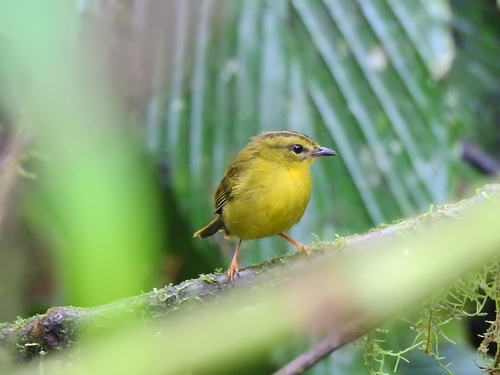
Cuzco Warbler
Myiothlypis chrysogaster
A vibrant golden gem of the Peruvian Andes, the Cuzco Warbler is a master of the humid cloud forest understory.
Quick Identification
Size
Approximately 13 cm (5.1 inches) in length; weight ranges from 11 to 14 grams (0.4 to 0.5 oz)
Colors
Bright yellow underparts and throat; olive-green upperparts; dark crown with a distinct yellow or orange-yellow median stripe; dark eye-stripe
Key Features
- Vibrant yellow underparts
- Dark crown with orange-yellow median stripe
- Olive-green back and wings
- Dark horizontal eye-line contrasting with yellow face
When You’ll See Them
Geographic range
Where Does the Cuzco Warbler Live?
Native to the South American continent, the Cuzco Warbler is an endemic specialist found exclusively along the eastern slopes of the Andes Mountains in Peru. It thrives in the lush, moisture-rich environments of humid montane forests and secondary growth, primarily spanning from the central regions of the country down through the southern Andean reaches. Its range is relatively narrow, hugging the specific elevational bands where the cloud forest meets the foothills.
Basemap © OpenStreetMap contributors
Behavior
The Cuzco Warbler is a high-energy, restless bird that spent much of its day darting through the dense undergrowth of montane forests. They are typically found in pairs or small family groups, often keeping to the lower to middle strata of the forest where they can find cover among the shadows. Unlike some bolder species, they are somewhat secretive, though their constant movement makes them easier to spot once you catch a glimpse of their golden plumage.
These warblers are frequently observed as core members of mixed-species foraging flocks, traveling alongside other Andean songbirds. They exhibit a characteristic tail-flicking or shivering motion while foraging, which may help flush out hidden insects. While they are generally wary of humans, they can become curious about slow-moving observers in their remote habitat.
EverydayEarth exclusive
Camera Tips
Capturing the Cuzco Warbler on camera requires a strategic focus on the forest floor and lower understory. Because these birds are 'skulkers' that prefer the safety of dense vegetation, you should place your AI-powered camera low to the ground—ideally between 1 and 3 feet high. Look for mossy logs or natural corridor-like gaps in the ferns where birds might move between foraging patches.
While they don't visit traditional seed feeders, they are highly attracted to water sources. In the humid Andean environment, a small, shallow forest seep or a dripping rock pool is an ideal location for a camera trap. The sound of moving water acts as a natural lure, bringing them into the frame for a bath or a quick drink, providing excellent opportunities for clear, stationary shots.
Speed is critical when configuring your camera settings. Cuzco Warblers are incredibly fast and rarely stay still for more than a second. Use the highest shutter speed setting available or a 'Burst' mode to capture multiple frames per trigger. If your camera allows for sensitivity adjustments, set it to 'High' to ensure the sensor picks up their rapid movements through the dark undergrowth.
Finally, consider the lighting conditions of the cloud forest. These environments are often dimly lit even during the day. If your camera has an adjustable flash, use a low-intensity fill-flash to illuminate their bright yellow chests without washing out the olive tones of their backs. Positioning the camera to face slightly away from the morning sun will help prevent lens flare in the misty Andean air.
Similar Species
Species that look similar or are commonly confused with Cuzco Warbler.
Choco Warbler
Geographically separated, found only north of Peru in Colombia, Ecuador, and Panama.
Two-banded Warbler
Has more prominent black facial stripes and a different crown pattern with less vibrant yellow.
Russet-crowned Warbler
Lacks the yellow median crown stripe, possessing a solid rufous/russet crown instead.
Frequently Asked Questions
Record Cuzco Warbler at your habitat
Connect a camera to start building your own species record — AI identifies every visitor automatically.