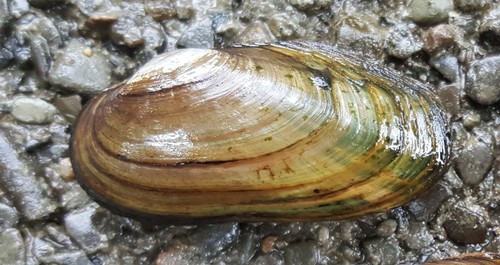
Cylindrical Papershell
Anodontoides ferussacianus
A delicate architect of the stream bed, the Cylindrical Papershell is a vital indicator of water health in North American headwaters. Its fragile, rayed shell hides a fascinating life cycle that links the river floor to the fish swimming above.
Quick Identification
Size
Typically 7–10 cm (2.8–4 inches) in length; weight varies by shell thickness but generally light and fragile.
Colors
Shell is yellowish-green, tan, or light brown, often featuring fine green rays across the surface; the interior nacre is a pearly white or silvery blue.
Key Features
- Thin and fragile shell ('papershell')
- Long, cylindrical or elliptical shape
- Fine, concentric ridges on the beak (umbone)
- Absence of strong teeth on the shell hinge
When You’ll See Them
Geographic range
Where Does the Cylindrical Papershell Live?
The Cylindrical Papershell is native to North America, primarily occupying the cool waters of the northern United States and southern Canada. Its range extends across the Great Lakes-St. Lawrence drainage basin and throughout the upper Mississippi River system, from the Dakotas and Nebraska eastward to New York and West Virginia. It is one of the more common mussels found in the headwaters of the Ohio and Missouri River basins, thriving in areas where larger, more robust mussel species cannot survive.
Basemap © OpenStreetMap contributors
Behavior
The Cylindrical Papershell is a sedentary filter feeder that spends most of its life partially buried in the substrate of freshwater ecosystems. Unlike many other freshwater mussels that prefer deep river channels, this species is often found in headwaters and small streams where it plays a critical role in purifying the water. By drawing water in through an incurrent siphon, it filters out microscopic particles, effectively acting as a natural water treatment plant for its local environment.
Its reproductive cycle is fascinating and involves a unique relationship with local fish populations. The larvae, known as glochidia, must attach themselves to the gills or fins of a host fish—typically the Creek Chub or various shiner species—to develop. They remain as harmless parasites for several weeks before dropping off to begin their lives as independent mussels on the stream floor. This reliance on specific fish makes them highly sensitive to changes in the local fish community.
EverydayEarth exclusive
Camera Tips
Capturing the Cylindrical Papershell on a backyard or trail camera requires a specialized approach since these animals live underwater and move very slowly. For the best results, use a waterproof action camera or a trail camera with a high-quality macro lens placed in shallow, clear stream margins during the low-water months of summer. Mounting the camera on a weighted base or a short tripod and positioning it at a 45-degree angle toward the sandy bottom will help you see the 'siphon' openings and the shell's distinct green rays.
Since mussels are stationary for long periods, time-lapse mode is your best friend. Set your camera to take a photo every 5 to 10 minutes over several hours. This will allow you to see the mussel slowly 'crawling' through the sand using its muscular foot—a movement that is nearly imperceptible to the naked eye. Avoid using traditional baits; instead, ensure your camera is positioned near the small 'slits' in the sand that indicate a buried mussel is active.
Lighting is crucial for underwater shots. In shallow water, natural sunlight is best, but if the water is shaded, a camera with a strong, diffused LED flash can bring out the iridescent nacre of the shell. Using a polarizing filter over the camera lens can also help eliminate surface glare from the water if the camera is positioned above the surface looking down. Be mindful of water clarity; after heavy rains, the sediment will likely obscure any footage, so wait for 48 hours of dry weather for the clearest images.
Similar Species
Species that look similar or are commonly confused with Cylindrical Papershell.
Frequently Asked Questions
Record Cylindrical Papershell at your habitat
Connect a camera to start building your own species record — AI identifies every visitor automatically.