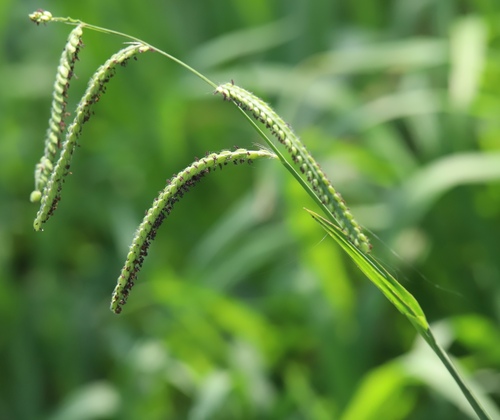
Dallis grass
Paspalum dilatatum
A champion of survival, Dallis grass is a resilient perennial known for its distinctive drooping seed heads and 'sticky' dispersal strategy. While often seen as a lawn pest, its rapid growth and adaptability make it a fascinating study in botanical persistence.
Quick Identification
Size
Height ranges from 50 to 150 cm (20 to 60 inches), with leaf blades 10 to 25 cm (4 to 10 inches) long.
Colors
Lime green to deep green foliage with seed heads featuring distinct purplish-black anthers and dark, fuzzy spikelets.
Key Features
- Long, hairless leaf blades with a prominent white midrib
- Coarse, clumping growth habit supported by short, thick rhizomes
- Flower stalks with 3-7 drooping branches carrying fuzzy, paired seeds
- Distinctive 'sticky heads' coated in a viscous substance during late summer
When You’ll See Them
Geographic range
Where Does the Dallis grass Live?
Native to the humid grasslands of South America, specifically Brazil, Argentina, and Uruguay, Dallis grass has become a successful globetrotter. It is now widely established across the southern half of North America, particularly in the humid Southeast and California. Beyond the Americas, it maintains a significant presence in southern Europe, Australia, New Zealand, and various tropical regions of Africa and Asia, often thriving wherever soil moisture is high and winters are mild.
Basemap © OpenStreetMap contributors
Behavior
Dallis grass is a hardy, perennial bunchgrass characterized by its aggressive growth and extreme resilience to heat and foot traffic. It spreads through a combination of prolific seed production and short, stout underground rhizomes, which allow the plant to store energy and survive even when the top growth is removed. Unlike many uniform turf grasses, Dallis grass grows in unsightly, coarse clumps that can quickly take over a manicured lawn if left unchecked.
A notable behavior of this species is its method of seed dispersal. The seed heads often become infected with a specific ergot fungus, which produces a sticky, honey-like substance. This makes the seeds adhere to the fur of passing animals, the blades of lawnmowers, or the clothing of humans, allowing the plant to 'hitchhike' to new locations. It is one of the first grasses to respond to summer rains, rapidly sending up tall seed stalks that can grow several inches in a single day.
EverydayEarth exclusive
Camera Tips
To effectively capture the growth of Dallis grass on an AI-powered backyard camera, position your device at a very low angle, roughly 6 to 10 inches above the ground. This perspective highlights the coarse texture of the leaves and the way the plant forms a 'rosette' or clump that differs from standard lawn grasses. Direct the camera toward a patch that receives full afternoon sun, as the backlighting will help illuminate the fine, fuzzy hairs on the seed heads, making them easier for AI algorithms to identify.
Because this species is stationary, it is the perfect candidate for time-lapse settings. Configure your camera to take a photo once every two to four hours during the peak growing months of July and August. This will allow you to see the remarkable speed at which the seed stalks emerge. You might notice that a stalk can go from non-existent to several inches tall in the span of a single warm, wet day.
If you are interested in the wildlife that interacts with Dallis grass, set your motion sensitivity to a medium level. While wind-blown blades can cause false triggers, the tall stalks often attract pollinators or small seed-eating birds like finches and sparrows. Placing the camera near a mature seed head in late summer provides a high chance of capturing these interactions. Avoid placing the camera too close to the 'sticky' seeds themselves, as the residue can smudge the lens if an animal brushes past the plant and then the camera.
Frequently Asked Questions
Record Dallis grass at your habitat
Connect a camera to start building your own species record — AI identifies every visitor automatically.