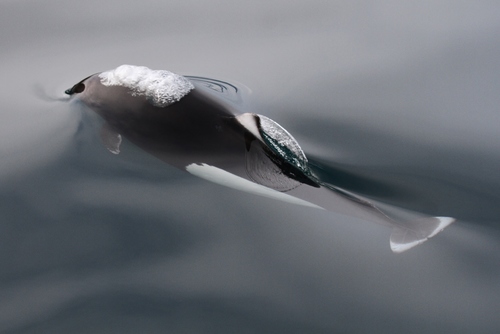
Dall's Porpoise
Phocoenoides dalli
The fastest porpoise in the world, the Dall's Porpoise is a high-energy acrobat of the North Pacific, recognizable by its 'rooster tail' spray and striking Orca-like markings.
Quick Identification
Size
Length of 1.7 to 2.4 meters (5.5 to 7.9 feet) and weight ranging from 130 to 220 kg (290 to 485 lbs).
Colors
Jet black body with a stark, large white patch on the belly and lower flanks; dorsal fin and tail flukes often have white or light gray 'frosting' on the edges.
Key Features
- Distinctive 'rooster tail' spray when surfacing at high speeds
- Striking black-and-white coloration resembling a miniature Orca
- Small, triangular dorsal fin with a white tip
- Extremely stocky, muscular build compared to other porpoises
When You’ll See Them
Geographic range
Where Does the Dall's Porpoise Live?
The Dall's Porpoise is a native of the North Pacific Ocean, thriving in cold-temperate and sub-arctic waters. Its range spans from the coastal waters of Southern California and Baja California, north through the Gulf of Alaska and the Bering Sea, and across to the Sea of Okhotsk and the Pacific coast of Japan. While they are most concentrated in the high-latitude waters of the United States, Canada, and Russia, they are year-round residents in many parts of their range where deep water provides consistent access to prey.
Basemap © OpenStreetMap contributors
Behavior
Dall's Porpoises are the fastest of all small cetaceans, capable of reaching incredible speeds of up to 55 km/h (34 mph). They are famous for their energetic behavior, particularly their habit of 'bow-riding'—seeking out the pressure waves of fast-moving boats to surf alongside them. When they swim rapidly just below the surface, they create a unique hollow cone of water known as a 'rooster tail,' which makes them easy to identify from a distance even before you see their bodies.
Unlike many other shy porpoise species, Dall's Porpoises are quite social and curious, often traveling in pods of 2 to 20 individuals. They are highly active hunters, frequently diving to depths of 100 meters or more to find prey. While they are mostly pelagic (open ocean) animals, they are known to approach shorelines where deep water is close to the coast, particularly in the fjords and inlets of the Pacific Northwest.
EverydayEarth exclusive
Camera Tips
Capturing the Dall's Porpoise on a trail camera requires a specialized setup since they are strictly marine animals. If you have a 'backyard' that overlooks a deep-water pier, a coastal cliff, or a fjord, position your camera at a slight downward angle toward the water. Because they move so quickly, a standard motion sensor may struggle; instead, use a camera with a high-speed trigger or set your device to a high-frequency timelapse mode (e.g., one shot every 5-10 seconds) during daylight hours.
Look for signs of the 'rooster tail' spray to identify high-traffic areas. These porpoises are often attracted to the movement of vessels, so if you are filming from a dock or a boat, keep the camera rolling whenever there is water turbulence nearby. Use a polarizing filter on your lens to reduce the glare from the ocean surface, which will help the camera's AI better detect the stark black-and-white contrast of the animal's body beneath the waterline.
For the best results, aim for days with 'glassy' water and low wind. High waves can create false triggers for motion sensors and hide the porpoise's small dorsal fin. If your camera allows for burst mode, set it to take 3-5 photos per trigger—this increases your chances of catching the animal mid-surface before it disappears back into the deep. While you can't attract them with food, placing your camera near areas where deep currents meet underwater ridges (known as upwellings) will naturally increase your odds of a sighting.
Similar Species
Species that look similar or are commonly confused with Dall's Porpoise.
Frequently Asked Questions
Record Dall's Porpoise at your habitat
Connect a camera to start building your own species record — AI identifies every visitor automatically.