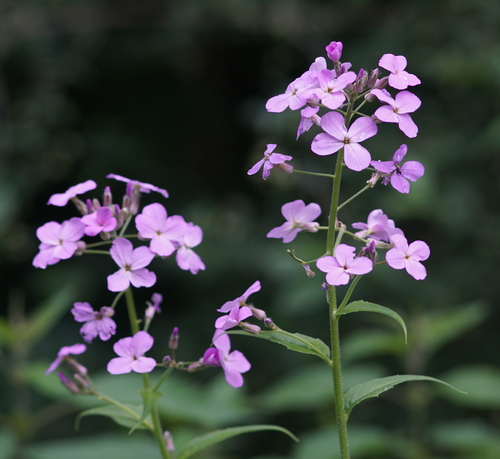
dame's rocket
Hesperis matronalis
Often mistaken for wild phlox, Dame's rocket is a fragrant powerhouse that transforms evening gardens into a sensory delight. With its cross-shaped blooms and intoxicating scent, it is a primary destination for the backyard's most mysterious nocturnal pollinators.
Quick Identification
Size
Height of 60–120 cm (2–4 feet) with a spread of 30–60 cm (1–2 feet)
Colors
Showy clusters of four-petaled flowers in lavender, purple, pink, or white; leaves are dark green
Key Features
- Four petals per flower arranged in a cross shape
- Lance-shaped leaves with fine teeth and an alternate arrangement
- Strong clove-like fragrance released primarily in the evening
- Long, thin seed pods called siliques that point upward
When You’ll See Them
Geographic range
Where Does the dame's rocket Live?
Originally native to the temperate regions of Europe and Asia, Dame's rocket has expanded its footprint significantly over the centuries. It is now widely naturalized across most of North America, from the southern reaches of Canada down through the majority of the United States, with particularly high densities in the Northeast and Midwest. This hardy plant thrives in almost any temperate climate where it can find sufficient moisture and disturbed soil to take root.
Basemap © OpenStreetMap contributors
Behavior
Dame's rocket is a biennial or short-lived perennial that focuses its first year on building a strong root system and a low-growing rosette of leaves. In its second year, it undergoes a dramatic transformation, shooting up tall, sturdy stalks crowned with vibrant floral clusters. While it is a static plant, its life cycle is dictated by the sun; the flowers are most fragrant during the evening and night hours, a strategy evolved to attract specific nocturnal pollinators like moths.
In the backyard ecosystem, Dame's rocket acts as a significant nectar source, often blooming in the 'gap' between early spring ephemerals and mid-summer perennials. However, it is a prolific self-seeder. A single plant can produce hundreds of seeds, allowing it to spread rapidly and form dense colonies. While humans appreciate its beauty and scent, it is often viewed as an opportunistic 'rogue' in North American landscapes because it can aggressively compete with native flora for space and nutrients.
EverydayEarth exclusive
Camera Tips
To capture the true essence of Dame's rocket, you must change your approach from motion-triggering to time-lapse photography. Because plants don't trigger traditional PIR sensors, use your camera's built-in time-lapse feature to take a photo every 15 to 30 minutes. This will allow you to create a mesmerizing video of the flowers opening and the stalks swaying as they grow. For the best visual impact, mount your camera on a low tripod or a garden stake, positioning the lens roughly 2 to 3 feet off the ground and angled slightly upward toward the flower clusters against a clear sky or a contrasting dark forest background.
The most exciting 'wildlife' action on Dame's rocket happens after dark. This plant is famous for its evening fragrance, which attracts spectacular insects like the White-lined Sphinx moth. To catch these 'hummingbird moths' in action, ensure your camera's infrared (IR) flash is active and set your video mode to a high frame rate. Position the camera very close—within 18 to 24 inches—to a particularly dense cluster of blooms. If your camera allows for sensitivity adjustments, set it to high to catch the rapid movement of moth wings as they hover in front of the petals.
Lighting is your biggest challenge and your best friend. Dame's rocket often grows in 'dappled' sunlight which can create harsh shadows and blown-out highlights on white or pale lavender petals. Try to position your camera so the sun is behind it or to the side during the 'Golden Hour' (just before sunset). This is when the purple hues of the flowers pop most vibrantly. If you are monitoring a backyard patch, consider using a soft, external battery-powered LED light hidden in the grass to provide a gentle 'fill light' for night shots, which will help the AI better identify the insects visiting the plant.
Similar Species
Species that look similar or are commonly confused with dame's rocket.
Frequently Asked Questions
Record dame's rocket at your habitat
Connect a camera to start building your own species record — AI identifies every visitor automatically.