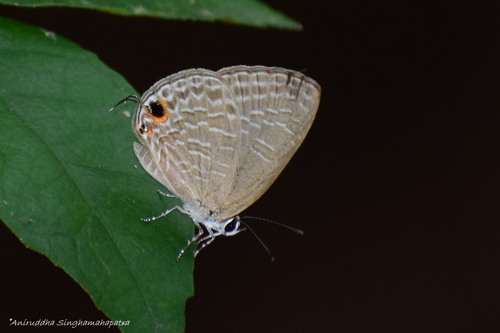
Dark Cerulean
Jamides bochus
A flash of metallic blue in the tropical sun, the Dark Cerulean is one of the most vibrant members of the 'Blues' family. Common in gardens across Asia, this territorial butterfly is a favorite for backyard naturalists and macro photographers alike.
Quick Identification
Size
Wingspan of 25–34 mm (1 to 1.3 inches)
Colors
Males feature a brilliant, metallic dark cerulean blue on the upperside with thick black borders; females are brownish with blue at the wing base. Both sexes have a pale chocolate-brown underside with delicate white-edged wavy lines.
Key Features
- Metallic dark blue upperside with broad black margins
- Underside marked with distinct white-edged wavy brown bands
- Prominent black eyespot with an orange crown on the hindwing
- Short, hair-like tails at the base of the hindwings
- Rapid, erratic flight path low to the ground
When You’ll See Them
Geographic range
Where Does the Dark Cerulean Live?
The Dark Cerulean is a quintessential species of the Indomalayan realm, thriving across a vast expanse of South and Southeast Asia. Its core range begins in the Indian subcontinent and Sri Lanka, stretching through Myanmar, Thailand, and Malaysia into the islands of Indonesia and the Philippines. While primarily an Asian species, it also reaches northward into Taiwan and has established populations in the coastal tropical regions of Queensland, Australia.
Basemap © OpenStreetMap contributors
Behavior
The Dark Cerulean is a fast-flying, energetic butterfly that acts like a living gemstone in the sunlight. Males are particularly territorial and will establish 'lookout' perches on the leaves of bushes or low trees. From these vantage points, they dart out to chase away other males or investigate potential mates, often returning to the exact same leaf after their sortie. This behavior makes them surprisingly predictable for observers who stay patient.
These butterflies are most active during the brightest parts of the day, as they rely on solar heat to power their rapid wing beats. While they spend much of their time visiting nectar-rich flowers, males are also frequently observed 'puddling.' They congregate on damp patches of soil or sand to suck up essential salts and minerals, which they then pass to females during mating to improve the viability of their eggs.
EverydayEarth exclusive
Camera Tips
To capture the Dark Cerulean on camera, focus on 'nectar highways'—patches of flowers like Lantana, Ixora, or Buddleia. Position your camera at a height of 2 to 3 feet, as these butterflies prefer foraging on mid-level shrubbery rather than high in the canopy. Because they are small and fast, a camera with a high-speed trigger or a dedicated macro lens is highly recommended. Set your shutter speed to at least 1/1000th of a second if you hope to freeze their motion mid-flight.
A unique trick for attracting the metallic males is to create a 'puddling station' within view of your camera. Place a shallow tray filled with damp sand and mix in a small amount of sea salt or a few drops of fermented fruit juice. Place this in a sunny spot on the ground. The males will land to extract minerals, providing a perfect opportunity for still shots while they are stationary and focused on feeding.
If you want to document their entire life cycle, mount your camera near 'host plants' like Rattlepods (Crotalaria). During the breeding season, females will hover slowly around these plants to deposit eggs on the flower buds. This slower flight pattern is much easier for AI-powered motion sensors to detect than their usual erratic darting. Ensure your camera is angled to catch the direct sunlight, as the characteristic metallic blue shimmer of the wings is only visible when the light hits them at the correct angle.
Similar Species
Species that look similar or are commonly confused with Dark Cerulean.
Frequently Asked Questions
Record Dark Cerulean at your habitat
Connect a camera to start building your own species record — AI identifies every visitor automatically.