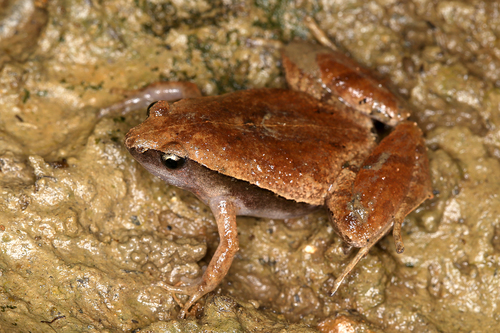
Dark-sided Chorus Frog
Microhyla heymonsi
A master of the forest floor, the Dark-sided Chorus Frog is a tiny powerhouse known for its bold 'racing stripes' and a voice that fills the tropical night. Small enough to sit on a coin, this adaptable amphibian thrives everywhere from remote jungles to suburban backyard ponds.
Quick Identification
Size
2.0–3.0 cm (0.8–1.2 inches) in length; females are generally larger and more robust than males.
Colors
Light pinkish-brown to greyish-brown back; broad, dark brown or blackish bands along the sides; often features a thin, pale vertebral stripe.
Key Features
- Distinct dark lateral bands from snout to groin
- Pointed snout and very small, narrow mouth
- Lack of webbing on front fingers
- High-pitched, creaking 'click' call
When You’ll See Them
Geographic range
Where Does the Dark-sided Chorus Frog Live?
This widespread amphibian is native to the tropical and subtropical regions of East and Southeast Asia. Its distribution spans from northeastern India and southern China through Taiwan, reaching south into Thailand, Vietnam, the Malay Peninsula, and Sumatra. It is a highly adaptable species that is frequently found in human-modified landscapes and agricultural zones.
Basemap © OpenStreetMap contributors
Behavior
The Dark-sided Chorus Frog is a secretive, primarily terrestrial species that is far more often heard than seen. Despite their small size, males produce a surprisingly loud, high-pitched chirping sound that resembles a rhythmic clicking or a creaking gate. They are most active during the monsoon or rainy seasons, when they congregate around temporary pools, ditches, and rice paddies to breed.
During the day, these frogs remain expertly camouflaged under leaf litter, logs, or within dense grass to avoid desiccation and predators. They are not strong swimmers compared to other frogs and prefer to stay near the water's edge rather than in deep water. Their movement consists of short, quick hops, and they are quick to tuck themselves into the mud if disturbed.
EverydayEarth exclusive
Camera Tips
Capturing the Dark-sided Chorus Frog on camera requires a specialized approach due to its diminutive size. Because these frogs are roughly the size of a thumb, standard trail cameras placed at human knee height will likely fail to trigger. Position your camera at ground level, no more than 2-3 inches off the substrate, and use a 'macro' or close-up lens setting if available. Angle the lens toward a damp patch of soil or the edge of a shallow puddle where you have heard their calls.
Timing is everything with this species. The best results occur during or immediately after heavy rainfall. Set your camera to video mode with audio enabled; the Dark-sided Chorus Frog’s call is its most identifying feature, and capturing the vocal sac inflating during a call makes for spectacular footage. Since they are strictly nocturnal, a high-quality infrared (No-Glow) flash is essential to capture clear images without overexposing the frog’s reflective skin.
If you are struggling to find them, try placing a low-wattage solar light in your garden. This attracts the small insects they prey upon, creating a natural bait station. Set your camera's trigger interval to the shortest possible time, as these frogs move in quick, erratic bursts and can disappear from the frame in a split second. Using 'Burst Mode' for still photos can help ensure at least one frame captures the frog in a clear, side-profile pose showing its namesake dark bands.
Similar Species
Species that look similar or are commonly confused with Dark-sided Chorus Frog.
Frequently Asked Questions
Record Dark-sided Chorus Frog at your habitat
Connect a camera to start building your own species record — AI identifies every visitor automatically.