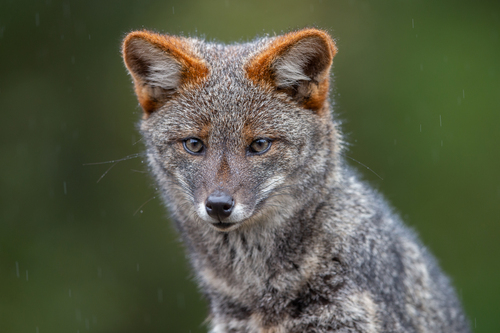
Darwin's Fox
Lycalopex fulvipes
The Darwin's Fox is one of the rarest and most elusive canids on Earth, a tiny forest dweller found only in the misty rainforests of Chile.
Quick Identification
Size
Head-body length of 48-60 cm (19-24 in) and weight between 1.9-4 kg (4.2-8.8 lbs)
Colors
Dark charcoal-grey to blackish body with distinctive rufous (reddish-brown) markings on the ears and lower legs; white or cream patches on the chin and underbelly
Key Features
- Significantly shorter legs than other South American foxes
- Dark, heavy coat with reddish-orange fur behind the ears
- Stocky build with a relatively broad, short muzzle
When You’ll See Them
Geographic range
Where Does the Darwin's Fox Live?
Darwin's Fox is a rare endemic species found only in a few isolated pockets of South America. It is native to the coastal regions of southern Chile, with its most significant population residing on Chiloé Island. Smaller, fragmented populations are also found on the Chilean mainland, specifically within the Nahuelbuta National Park and the coastal mountain ranges of the Los Ríos and Los Lagos regions. This species is a true specialist of the Valdivian temperate rainforest, never naturally occurring outside of this specific Chilean ecosystem.
Basemap © OpenStreetMap contributors
Behavior
Darwin's foxes are largely solitary and secretive residents of the deep forest, though they are known to be surprisingly bold and curious when encountering humans. Unlike many other wild canids that flee at the first sign of activity, these foxes may linger to observe observers, a trait that unfortunately makes them vulnerable to domestic dog attacks. They are primarily crepuscular and nocturnal, navigating the dense temperate rainforest understory with ease thanks to their compact size and short limbs.
Socially, they maintain home ranges that they defend from rivals, although pairs may share territory during the breeding season. They communicate through a series of sharp yaps and scent marking. Because they evolved in an environment with few natural predators, they lack the extreme skittishness seen in mainland foxes, making them a unique subject for patient wildlife observers and researchers.
EverydayEarth exclusive
Camera Tips
To capture a Darwin's Fox on camera, focus your efforts on the transition zones between dense forest and small openings. These foxes are masters of the undergrowth, so placing cameras in heavy thickets or along narrow trails through 'Quila' (native bamboo) is your best bet. Set your camera height quite low—about 12 inches (30 cm) off the ground—to frame their short-legged profile correctly. Because of their dark fur, they can be difficult to see against a night background; using a camera with high-contrast black-and-white infrared mode will help the lighter markings on their chin and ears stand out.
Curiosity is one of their defining traits. While you should never feed an endangered species, 'novelty' lures like a rag soaked in a mild fruit scent or even a hanging reflective object can cause them to pause and investigate your camera site. This brief pause is essential for getting a clear, blur-free image. Make sure your camera has a very fast trigger speed (0.3 seconds or less), as they move quickly and fluidly through the brush.
Environmental protection for your gear is crucial. The Chilean rainforest is one of the wettest places on earth, so use a high-quality waterproof security box and include silica gel desiccant packs inside the camera housing to prevent lens fogging. Check your cameras during the summer months (December to February) to capture images of pups, which are usually born in the spring and begin foraging with their parents as the weather warms up.
Frequently Asked Questions
Record Darwin's Fox at your habitat
Connect a camera to start building your own species record — AI identifies every visitor automatically.