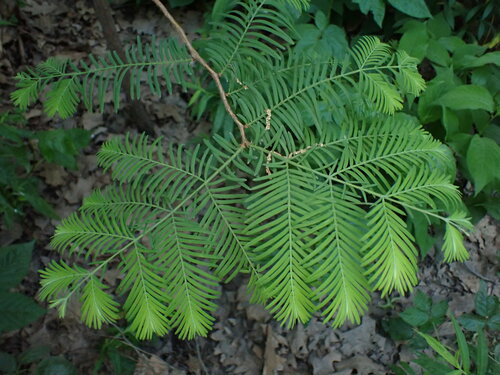
dawn redwood
Metasequoia glyptostroboides
A living fossil once thought extinct, the dawn redwood is a fast-growing giant that transforms from emerald green to brilliant copper each year.
Quick Identification
Size
Grows to 130–160 feet (40–50 m) tall; trunk diameter typically 3–7 feet (1–2 m)
Colors
Bright emerald green foliage in spring/summer, turning copper or reddish-bronze in autumn; reddish-brown shredded bark
Key Features
- Opposite leaf arrangement on branchlets
- Deciduous needles that shed in autumn
- Deeply fluted, buttressed trunk base with 'armpits' under branches
- Symmetrical, pyramidal growth habit
When You’ll See Them
Geographic range
Where Does the dawn redwood Live?
The dawn redwood is native to the temperate regions of south-central China, specifically localized in the border regions of Hubei, Hunan, and Chongqing. While its wild population is restricted to these small montane pockets, it has been successfully introduced as an ornamental tree across the globe. Today, thriving populations can be found in parks and suburban landscapes throughout North America, Europe, and Japan, where it adapts well to various temperate climates.
Basemap © OpenStreetMap contributors
Behavior
The dawn redwood is a biological marvel often referred to as a 'living fossil.' For millions of years, it was known only through the fossil record and believed to be extinct until a small stand was rediscovered in rural China in the 1940s. Unlike most conifers, this species is deciduous, meaning it sheds its soft, feathery needles every autumn after a spectacular display of copper and bronze coloration. It is one of the fastest-growing trees in the world, capable of adding several feet of height per year when young.
In a backyard or park setting, the dawn redwood acts as a massive carbon sink and a structural anchor for the local ecosystem. While it doesn't 'behave' in the animal sense, it interacts dynamically with its environment by drawing up vast amounts of water and providing a high-altitude sanctuary for nesting birds and climbing mammals. Its bark becomes deeply fissured with age, creating micro-habitats for beneficial insects and spiders.
EverydayEarth exclusive
Camera Tips
To capture the majesty of a dawn redwood on a trail camera, focus on the 'long game.' Because trees don't move, these are perfect subjects for time-lapse photography. Set your camera to take a photo once a day at noon to document the incredible transformation from the lime-green buds of spring to the fiery copper needles of autumn. This reveals the tree's unique deciduous nature in a way that single photos cannot.
For wildlife monitoring, place your camera about 5 to 6 feet up a neighboring tree, angled slightly downward toward the dawn redwood's trunk. The deep 'armpits' or fluting at the base of the tree are popular hiding spots for small mammals and reptiles. If you are looking to capture bird activity, aim your camera at the lower horizontal branches where songbirds often perch before moving into the denser canopy.
Don't ignore the bark texture. Use a macro-capable camera or a close-focus setting to capture the shredded, reddish-brown bark. This is where you will find the 'hidden' backyard wildlife—woodpeckers searching for larvae, or squirrels utilizing the fibrous bark for nesting material. During the winter months, the bare, skeletal structure of the tree provides high-contrast shots against the snow, making it an excellent backdrop for capturing passing deer or foxes.
Similar Species
Species that look similar or are commonly confused with dawn redwood.
Frequently Asked Questions
Record dawn redwood at your habitat
Connect a camera to start building your own species record — AI identifies every visitor automatically.