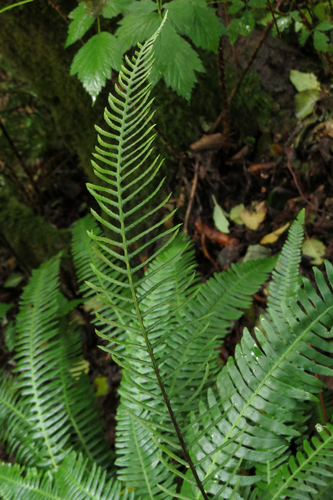
deer fern
Struthiopteris spicant
A resilient evergreen of the forest floor, the deer fern is easily identified by its unique 'ladder-style' leaves and its role as a vital winter food source for forest wildlife.
Quick Identification
Size
Sterile fronds typically range from 20–50 cm (8–20 in) in length, while upright fertile fronds can reach 100 cm (40 in).
Colors
Glossy, deep forest green sterile fronds; fertile fronds are thinner and turn brownish-black as spores mature.
Key Features
- Dimorphic fronds with flat sterile leaves and upright fertile leaves
- Symmetrical, ladder-like pinnate leaflets
- Leathery, evergreen texture on sterile fronds
When You’ll See Them
Geographic range
Where Does the deer fern Live?
The deer fern is native to the temperate regions of the Northern Hemisphere, with its most robust populations found along the Pacific coast of North America from Alaska to California. Beyond the Americas, it is widely distributed across Europe, including the British Isles and Scandinavia, and extends into parts of Northeast Asia and Japan. It thrives in maritime climates where humidity is high and temperature fluctuations are moderated by the ocean.
Basemap © OpenStreetMap contributors
Behavior
The deer fern is a hardy, evergreen perennial known for its 'dimorphic' growth habit, meaning it produces two distinct types of fronds. The sterile fronds are leathery and grow in a low-lying rosette, often hugging the ground to stay protected from wind and cold. In contrast, the fertile fronds emerge from the center of the plant, standing stiffly upright to allow the wind to more effectively disperse their spores. This growth strategy ensures the plant remains low-profile for survival while maximizing its reproductive reach.
While the fern does not 'behave' in the animal sense, it interacts significantly with its environment by providing year-round ground cover. It is highly shade-tolerant and thrives in the damp, acidic conditions of old-growth forests. In the winter, when other food sources are buried under snow or have died back, the deer fern remains green and accessible, serving as a vital 'life-raft' food source for woodland mammals.
EverydayEarth exclusive
Camera Tips
While the deer fern is a stationary plant, it is one of the best 'anchor species' for trail camera placement in the Pacific Northwest and Europe. Because it is an evergreen winter food source, placing your camera at a low angle near a cluster of deer fern is a proven strategy for capturing footage of black-tailed deer, elk, and various rodents. Position the camera about 12 to 18 inches off the ground to catch the animals at eye level as they lean down to graze on the fronds.
For those interested in the plant itself, use a 'Time Lapse' mode rather than relying on motion triggers. Motion sensors are rarely tripped by the slow sway of a fern in the breeze. By setting your camera to take a photo every 30 minutes during the spring months (March to May), you can capture the dramatic 'unfurling' of the crosiers—the tightly coiled young fronds often called fiddleheads—as they expand into full leaves.
To get the best visual quality, consider the lighting of the forest floor. Ferns look best in dapple-shaded 'bright shade.' Direct noon sun can create harsh highlights that wash out the deep green color, so try to frame your shot in a spot that receives consistent indirect light. If your camera has a macro or close-focus setting, use it to capture the underside of the fertile fronds, where the spore-producing sori form beautiful, geometric patterns along the midrib.
Similar Species
Species that look similar or are commonly confused with deer fern.
Western Sword Fern
Much larger growth habit; lacks the distinct tall, narrow fertile fronds; each leaflet has a small 'thumb' at the base.
Licorice Fern
Typically grows on the mossy bark of trees rather than the ground; leaflets are fused to the central stem rather than separate.
Hard Shield Fern
Fronds are more leathery and stiff, with bristle-tipped teeth on the leaf margins.
Frequently Asked Questions
Record deer fern at your habitat
Connect a camera to start building your own species record — AI identifies every visitor automatically.