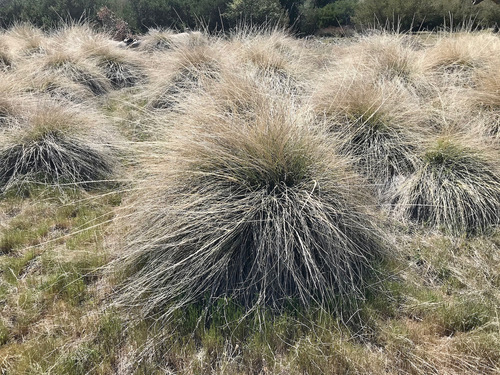
deergrass
Muhlenbergia rigens
A majestic bunchgrass of the American West, deergrass provides a shimmering silver sanctuary for backyard wildlife. This drought-tolerant powerhouse is a favorite hiding spot for everything from tiny lizards to nesting birds.
Quick Identification
Size
3 to 5 feet (0.9 to 1.5 meters) in height and up to 4 feet (1.2 meters) in width
Colors
Deep green to silver-gray foliage; flower stalks are tan, straw-colored, or occasionally purple-tinged
Key Features
- Large, dense, symmetrical bunchgrass mound
- Slender, spike-like flower panicles up to 3 feet long
- Narrow, tough, wire-like leaf blades
- Evergreen to semi-evergreen appearance
When You’ll See Them
Geographic range
Where Does the deergrass Live?
Deergrass is native to the North American continent, specifically localized within the arid and semi-arid regions of the Southwestern United States and Mexico. Its core range spans from the coastal ranges and foothills of California eastward into Arizona, New Mexico, and parts of Texas. South of the border, it thrives across the Mexican plateau, reaching as far as Puebla, often congregating near seasonal water sources or in well-drained mountain washes.
Basemap © OpenStreetMap contributors
Behavior
Ecologically, the plant acts as a 'living hotel.' The dense interior of the bunch provides a microclimate that is cooler and more humid than the surrounding air, offering a critical refuge for lizards, toads, and small mammals during the heat of the day. In the autumn, the tall, stiff flower stalks provide perches for dragonflies and small birds like finches, who come to forage on the seeds.
EverydayEarth exclusive
Camera Tips
When filming wildlife around deergrass, the best strategy is to aim your camera at the base of the plant. Many small animals, such as rabbits, quail, and lizards, use the dense 'skirt' of the grass as a hiding spot. Mount your camera on a low stake about 6 to 10 inches off the ground, angled slightly upward to capture the activity emerging from the foliage. This low angle also highlights the dramatic texture of the grass blades.
If you are interested in capturing birds or insects, focus your camera on the tall, wand-like flower stalks during late summer and autumn. Finches often land on these stalks to feed on the seeds, causing the grass to sway gracefully. Because the movement of the grass in the wind can cause 'false triggers' on motion-sensitive cameras, try to use a camera with 'zone masking' or set the sensitivity to a medium level to avoid hundreds of videos of just moving grass.
Lighting is key for capturing the beauty of deergrass. If possible, position your camera facing north or south to avoid direct glare, but try to find a spot where the early morning sun can 'backlight' the grass. This creates a halo effect on the seed heads, making for stunning, professional-quality footage. In suburban settings, deergrass near a water feature is a goldmine for trail camera activity, as animals will often pause in the safety of the grass before approaching the water.
Similar Species
Species that look similar or are commonly confused with deergrass.
Frequently Asked Questions
Record deergrass at your habitat
Connect a camera to start building your own species record — AI identifies every visitor automatically.