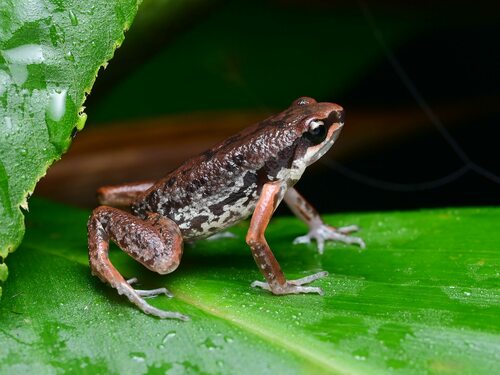
Deli Little Pygmy Frog
Micryletta inornata
Meet the Deli Little Pygmy Frog, a miniature marvel of the Sumatran rainforest. This 'narrow-mouthed' specialist is so small it can hide under a single fallen leaf, emerging only during tropical downpours.
Quick Identification
Size
18–26 mm (0.7–1.0 inches) in length
Colors
Dull reddish-brown to greyish-brown back with dark marbling; cream-colored belly with dark spots; distinctive dark stripe from snout to flank
Key Features
- Extremely small, slender body under 1 inch
- Dark lateral stripe passing through the eye
- Pointed snout with a narrow mouth opening
- Smooth skin without prominent warts or ridges
When You’ll See Them
Geographic range
Where Does the Deli Little Pygmy Frog Live?
This elusive amphibian is native to the tropical landscapes of Southeast Asia, specifically endemic to the island of Sumatra in Indonesia. Within this region, its core range is historically centered around the Deli region of North Sumatra, where it thrives in the humid, lowland forest floors. While related species in the Micryletta genus are found across the mainland, the Deli Little Pygmy Frog is a localized specialist with no known introduced populations outside of its native Sumatran habitat.
Basemap © OpenStreetMap contributors
Behavior
During these breeding events, males congregate around shallow, still water and emit a high-pitched, insect-like chirping call to attract females. Outside of the breeding season, they are solitary hunters. Their movement is characterized by short, quick hops rather than long leaps, allowing them to vanish into thick vegetation at the slightest sign of danger. Unlike some bolder frog species, they do not tolerate human presence well and will immediately go silent and still if they sense vibrations from footsteps.
EverydayEarth exclusive
Camera Tips
Capturing the Deli Little Pygmy Frog on camera requires a specialized approach due to its tiny size and forest-floor habitat. You must place your camera at absolute ground level, ideally slightly recessed into the leaf litter or angled downward at a 45-degree angle toward a small, clear patch of damp earth. Because these frogs are so small, standard PIR (passive infrared) sensors often fail to trigger; we highly recommend setting your camera to a time-lapse mode during the first 4 hours of darkness, taking a photo every 30 to 60 seconds.
Focus is the biggest challenge for this species. If you are using a standard trail camera, you may need to attach a +2 or +4 close-up macro lens over the existing lens to bring the focus point down to 10-20 centimeters. Without this, the frog will appear as a blurry brown smudge. Ensure your camera is placed near 'ephemeral' water sources—areas where puddles form after a storm—as this is where they are most likely to remain stationary for calling and mating.
Lighting should be handled carefully. High-intensity white flashes will likely wash out the delicate patterns of the frog's skin and may cause them to flee. Use 'No-Glow' or 'Black' infrared LEDs to capture their natural behavior without disturbance. If you are setting up in a backyard near a forest edge, maintaining a patch of 'wild' leaf litter and avoiding chemical pesticides will significantly increase your chances of a sighting during the wet season.
Frequently Asked Questions
Record Deli Little Pygmy Frog at your habitat
Connect a camera to start building your own species record — AI identifies every visitor automatically.