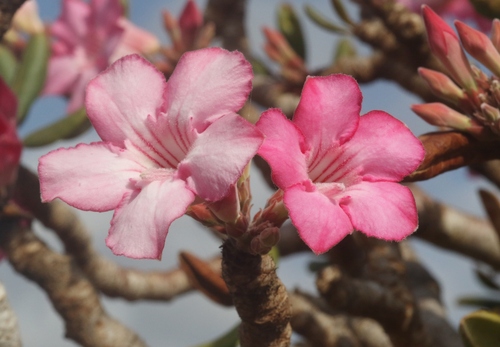
desert rose
Adenium obesum
A sculptural wonder of the arid world, the desert rose combines a rugged, swollen trunk with delicate, trumpet-shaped blooms. This resilient succulent is a master of survival, turning harsh sun into a brilliant display of desert color.
Quick Identification
Size
In the wild, it grows 1–3 m (3.3–9.8 ft) tall; cultivated plants are often 30–60 cm (1–2 ft).
Colors
Flowers are pink, red, or white, often with a lighter throat; leaves are bright green; bark is smooth and grey.
Key Features
- Bulbous, swollen base known as a caudex
- Trumpet-shaped five-lobed flowers
- Thick, fleshy succulent-like branches
- Leathery leaves clustered at branch tips
- Milky, toxic sap
When You’ll See Them
Geographic range
Where Does the desert rose Live?
The desert rose is native to the sun-drenched Sahel regions of Africa, forming a wide belt that stretches from Senegal in the west to Ethiopia and Somalia in the east. It is also a prominent fixture in the landscapes of the Arabian Peninsula, particularly in Yemen, Oman, and Saudi Arabia, as well as parts of tropical eastern and southern Africa. Due to its popularity as an ornamental, it has been introduced and naturalized in many tropical and subtropical regions worldwide, including Thailand, India, and the southern United States, where it is a favorite for xeriscaping.
Basemap © OpenStreetMap contributors
Behavior
The desert rose is a drought-deciduous succulent that has adapted to harsh, arid environments by storing water in its thick, swollen stem and roots. In its native habitat, it may drop its leaves during particularly dry periods to conserve moisture, entering a dormant state until the rains return. Its growth is slow but steady, eventually forming a sculptural, tree-like shape even in small containers.
As a defensive strategy, the plant produces a highly toxic milky sap containing cardiac glycosides, which discourages herbivores from grazing on its fleshy stems. While it remains stationary, it interacts dynamically with the environment by timing its vibrant floral displays to attract long-tongued pollinators like hawkmoths and certain bee species. In human environments, it is prized for its resilience and ability to thrive in high-heat conditions where other flowering plants might wither.
EverydayEarth exclusive
Camera Tips
Capturing the beauty of a desert rose with a trail or backyard camera requires a focus on detail and timing rather than movement. To showcase the plant's unique sculptural form, place your camera on a low tripod or mount it about 1 to 2 feet off the ground, angled slightly upward. This perspective emphasizes the swollen caudex (the base), which is one of the plant's most interesting features. If you are aiming to capture its vibrant blooms, ensure the camera is positioned to receive bright, indirect morning light; direct midday sun can often wash out the deep pink and red hues of the petals.
Because the desert rose is a stationary subject, the best use of a camera is setting it to time-lapse mode. Configure your camera to take a photo every 30 to 60 minutes during the daylight hours over the course of a week when buds are present. This will allow you to create a stunning video of the flowers unfurling, which typically happens slowly over several days. If you use a motion-trigger setting, focus on the flowers to catch visitors like hawkmoths, which are most active at dusk, or colorful sunbirds and bees that frequent the blooms for nectar.
Avoid placing the camera too close if you are in a high-humidity environment, as the fleshy leaves can transpire and fog the lens in the early morning. A distance of 3 to 5 feet with a slight zoom is usually ideal for a crisp, clear image. Since the desert rose is toxic, you don't need to worry about animals knocking over the camera to eat the plant, but do ensure the tripod is weighted down if you live in a windy, open area where these plants typically thrive.
Frequently Asked Questions
Record desert rose at your habitat
Connect a camera to start building your own species record — AI identifies every visitor automatically.