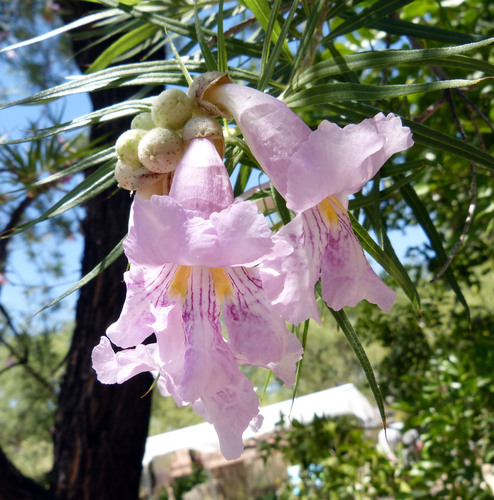
desert willow
Chilopsis linearis
A hardy desert survivor with a soft side, the desert willow dazzles with orchid-like blooms and provides a vital oasis for hummingbirds and butterflies across the arid Southwest.
Quick Identification
Size
Height: 4.5–9 meters (15–30 feet); Width: 3–6 meters (10–20 feet); Trunk diameter up to 30 cm (12 inches)
Colors
Bright green leaves; flowers in shades of pink, lavender, and white with yellow nectar guides; gray-brown shaggy bark
Key Features
- Narrow, willow-like leaves up to 12 inches long
- Fragrant, trumpet-shaped flowers with fringed lobes
- Long, slender, pencil-like seed pods
- Twisted, multi-trunked growth habit
When You’ll See Them
Geographic range
Where Does the desert willow Live?
The desert willow is native to the arid landscapes of North America, specifically the Southwestern United States and Northern Mexico. Its core range spans from the Mojave Desert in California and Nevada through the Sonoran and Chihuahuan Deserts of Arizona, New Mexico, and West Texas. In Mexico, it is widely distributed across the northern states of Chihuahua, Sonora, and Coahuila, typically following the paths of seasonal watercourses.
Basemap © OpenStreetMap contributors
Behavior
Despite its common name, the desert willow is not a true willow; it is a member of the Bignoniaceae family, making it a close relative of the catalpa tree. It is a drought-deciduous species, often shedding its leaves during particularly dry summers or cold winters to preserve its internal moisture. This tree is an essential survivalist of the desert, frequently found along dry washes where its roots can reach deep-seated water tables.
The tree is a hub of social activity in the animal kingdom. Its spectacular blooming period, which typically follows the arrival of seasonal rains, provides a massive influx of nectar for high-energy flyers. Because it is a fast-grower with a penchant for developing hollows and dense branching as it ages, it serves as a critical nesting and sheltering site for various desert birds and small mammals looking to escape the midday heat.
EverydayEarth exclusive
Camera Tips
To capture the best wildlife action on your desert willow, focus your camera on the flower clusters rather than the trunk. Use a high-speed trigger or video mode to catch the lightning-fast movements of hummingbirds and sphinx moths that visit the trumpet-shaped blooms. Aim your lens at eye-level with the branches, ideally 4 to 6 feet away from a dense patch of flowers, to get crisp details of the pollinators' wings and the intricate yellow nectar guides inside the blossoms.
Positioning is key to managing the harsh desert light. Try to place your camera on the southern side of the tree facing north, or vice-versa, to ensure the flowers are backlit or evenly lit rather than washed out by the direct overhead sun. Early morning is the magic hour for desert willow activity; nectar production peaks just after sunrise, making 7 AM to 10 AM the most productive window for capturing high-traffic scenes.
Don't overlook the ground-level ecosystem that the desert willow creates. The leaf litter and low-hanging branches provide excellent cover for Gambel's Quail, roadrunners, and various lizard species. Setting up a secondary camera near the base of the trunk or aimed at a nearby ground-level water source can capture the terrestrial side of the tree’s visitors. If your camera has a time-lapse feature, use it during the 'monsoon' months (July and August) to watch how rapidly the tree bursts into a second wave of blooms after a heavy rain.
Similar Species
Species that look similar or are commonly confused with desert willow.
Western Redbud
The Redbud has distinct heart-shaped leaves and smaller pea-like flowers compared to the long leaves and trumpet flowers of the desert willow.
Southern Catalpa
A close relative with similar flowers, but the Catalpa has massive, broad leaves and requires much more water than the desert willow.
Frequently Asked Questions
Record desert willow at your habitat
Connect a camera to start building your own species record — AI identifies every visitor automatically.