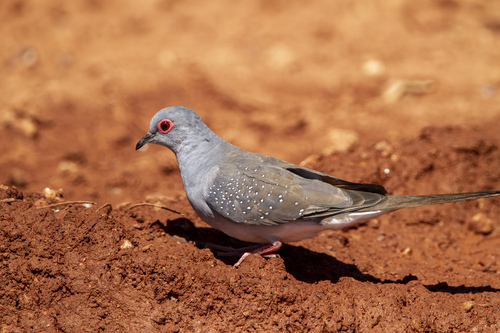
Diamond Dove
Geopelia cuneata
Meet the Diamond Dove, a tiny, desert-dwelling gem of the Australian outback. With its shimmering spotted wings and vibrant red eye-rings, this elegant bird is a favorite for backyard observers.
Quick Identification
Size
Length: 19-21 cm (7.5-8.3 inches); Wingspan: 28-32 cm (11-12.5 inches); Weight: 23-40 grams (0.8-1.4 oz)
Colors
Blue-grey head and neck; soft brown-grey wings speckled with small white 'diamond' spots; pale white underbelly; distinctive orange-red fleshy eye-ring
Key Features
- Smallest pigeon in Australia alongside the Peaceful Dove
- White spotting on wings
- Vibrant red-orange ring around the eye
- Long, slender tail with white outer feathers
When You’ll See Them
Geographic range
Where Does the Diamond Dove Live?
Native to the Australian continent, the Diamond Dove is a quintessential resident of the vast interior. Its core range spans across Central, Western, and Northern Australia, where it thrives in dry landscapes. During periods of extreme inland drought, these nomadic birds are known to wander further south, occasionally appearing in the parks and coastal gardens of Southern Australia as they search for water.
Basemap © OpenStreetMap contributors
Behavior
The Diamond Dove is a social and gentle species, typically encountered in pairs or small family groups. They spend the vast majority of their day on the ground, walking with a characteristic rhythmic head-bobbing motion as they forage. Despite their delicate, almost ornamental appearance, they are remarkably hardy birds, well-adapted to the harsh temperature fluctuations of the Australian outback.
While naturally shy, they can become quite confident in backyards if provided with a quiet environment and a consistent water source. They are known for their mournful, repetitive cooing and a sudden, noisy wing-clap when they take flight. During the hottest parts of the day, they are likely to be found resting quietly in the lower branches of shrubs or trees, blending in perfectly with the dappled shade.
EverydayEarth exclusive
Camera Tips
To capture the Diamond Dove on your AI-powered camera, you must focus on the ground. These birds are dedicated foragers and rarely feed from hanging bird feeders. Position your camera just 10 to 20 centimeters (4-8 inches) off the ground, aiming the lens at a patch of bare earth or short-cropped grass. Because they are so small, a slightly downward angle will help you capture the intricate white spotting on their wings that gives them their name.
Water is the most effective lure for this species. In dry climates, a shallow birdbath or a simple ground-level water tray is irresistible to Diamond Doves. Place your camera near the water's edge, but ensure there is some low cover, such as a shrub or bush, within a meter or two. They prefer to 'scout' the area from a low branch before committing to a landing on the ground to drink.
If you want to encourage frequent visits, scatter a mix of very fine wild bird seeds or millet directly on the soil. They have small, delicate beaks and cannot easily handle large grains or sunflower seeds. Setting your camera to take short, high-resolution video clips rather than just still photos will allow you to see their unique bowing and tail-fanning courtship displays. Since they are most active in the cooler morning hours, ensure your camera's sensitivity is high enough to trigger in the soft light of dawn.
Similar Species
Species that look similar or are commonly confused with Diamond Dove.
Frequently Asked Questions
Record Diamond Dove at your habitat
Connect a camera to start building your own species record — AI identifies every visitor automatically.