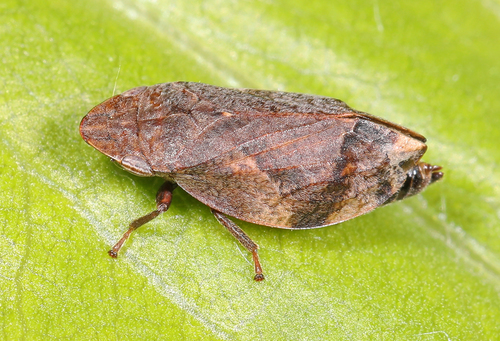
Diamondback Spittlebug
Lepyronia quadrangularis
Master of the 'cuckoo spit' and an incredible jumper, the Diamondback Spittlebug is a hidden gem of the backyard insect world. Look for its signature diamond-patterned wings and frothy nests among the summer grasses.
Quick Identification
Size
Adults typically measure 6 to 9 mm (0.24 to 0.35 inches) in length.
Colors
Mottled brownish-tan with two dark brown oblique bands forming a diamond or 'X' shape; small black curved marks at the wing tips.
Key Features
- Distinctive dark brown 'X' or diamond pattern on wings
- Wedge-shaped, robust body profile
- Small black crescent marks at the wing tips
- Powerful hind legs designed for jumping
- Produces frothy white bubbles as a nymph
When You’ll See Them
Geographic range
Where Does the Diamondback Spittlebug Live?
The Diamondback Spittlebug is native to North America, where it maintains a broad and healthy distribution. It is found throughout the United States, from the Atlantic coast through the Great Plains, and extends north into southern Canada. While most prevalent in the eastern and central regions, its ability to utilize various host plants allows it to thrive in diverse ecological zones ranging from temperate grasslands to subtropical garden edges.
Basemap © OpenStreetMap contributors
Behavior
The Diamondback Spittlebug is renowned for its unique juvenile stage, during which the nymphs produce a protective white froth commonly known as 'cuckoo spit.' This foam is created by the nymph excreting a fluid rich in plant sap and whipping it into a bubbly mass with its hind legs. This substance serves multiple purposes: it insulates the soft-bodied insect against heat and cold, provides essential moisture to prevent desiccation, and acts as a deterrent to predators who find the sticky, bitter bubbles unappealing.
As adults, these insects are commonly referred to as 'froghoppers' due to their impressive leaping abilities. When threatened, they use their specialized hind legs to catapult themselves many times their body length into the air, often vanishing from sight before a predator can react. Unlike the sedentary nymphs, adults are active and mobile, though they spend much of their time inconspicuously perched on plant stems, perfectly camouflaged against dried grass and bark.
EverydayEarth exclusive
Camera Tips
Capturing the Diamondback Spittlebug on camera requires a dedicated macro setup or a high-resolution trail camera with a very close focal point. Because these insects are small—less than a centimeter long—you should position your camera roughly 6 to 10 inches from potential host plants. Look for 'spittle' foam on grass stems in late spring; these are the spots where adults are most likely to emerge and remain nearby later in the summer.
Placement is everything for these tiny jumpers. Focus your lens on the flower heads of goldenrod, clover, or tall native grasses. Use a tripod to maintain a steady frame, and if your camera allows, set a fast shutter speed of at least 1/500th of a second. These insects are famous for their 'froghopper' leap, and a slow shutter will result in a blur if they decide to jump just as the sensor triggers. Side-lighting from the early morning or late afternoon sun is ideal, as it highlights the textured 'diamond' pattern on their wings that gives them their name.
To attract them to a specific spot for your camera, avoid mowing a small patch of your lawn and allow native herbs and grasses to grow tall. Unlike mammals, you can't bait them with food, but you can bait them with habitat. Ensure your camera is set to its highest resolution or 'Macro Mode' if available, and consider using a background that provides high contrast—like a dark green leaf—to make the brown and tan mottled patterns of the spittlebug pop in your photos.
Similar Species
Species that look similar or are commonly confused with Diamondback Spittlebug.
Frequently Asked Questions
Record Diamondback Spittlebug at your habitat
Connect a camera to start building your own species record — AI identifies every visitor automatically.