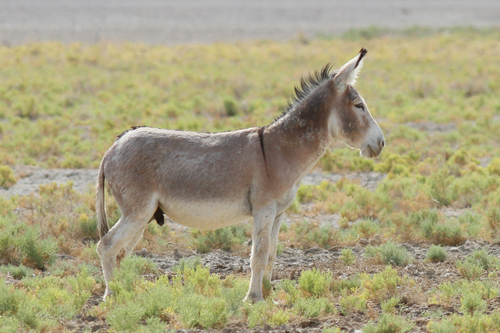
Donkey
Equus asinus
The donkey is a symbol of endurance and surprising intelligence. From their iconic long ears to their powerful brays, these social equines are a delightful addition to any rural or backyard camera setup.
Quick Identification
Size
Height at withers: 79–160 cm (31–63 in); Weight: 80–480 kg (180–1,060 lb)
Colors
Commonly gray, dun, or brown with a white muzzle, belly, and eye rings. Many feature a dark 'cross' stripe over the shoulders.
Key Features
- Large, upright ears often tipped with dark hair
- Narrow, boxy hooves adapted for rocky terrain
- Short, upright mane without a forelock
- Tail with hair only at the lower end
When You’ll See Them
Geographic range
Where Does the Donkey Live?
Originally native to the arid regions of Northeast Africa, the donkey has been introduced to every continent except Antarctica due to its long history as a working animal. Today, they are most prevalent in developing nations across Asia, Africa, and South America, while also maintaining a strong presence on hobby farms and in feral populations across the United States, Australia, and Southern Europe.
Basemap © OpenStreetMap contributors
Behavior
Donkeys are highly social and intelligent animals with a strong sense of self-preservation. Unlike horses, which tend to flee when startled, donkeys often freeze or move only a short distance to assess a perceived threat. This cautious behavior is frequently misinterpreted as stubbornness, but it is actually a sign of their cognitive depth and survival instinct.
In a group setting, they form tight-knit bonds and can become visibly distressed when separated from their companions. They communicate through a wide range of vocalizations, most notably their powerful, two-tone bray which can carry for miles in open terrain. In many parts of the world, they are used as guardian animals for livestock because they are naturally aggressive toward canines like coyotes and dogs.
EverydayEarth exclusive
Camera Tips
When setting up a camera to capture donkeys, placement height is critical. Aim for chest height—roughly 3 to 4 feet off the ground—to ensure you capture their facial features and large ears without the camera looking too far up or down. Because donkeys are naturally curious and often use sturdy objects as 'scratching posts,' ensure your camera is secured in a protective steel security box or mounted to a very thick post that won't wobble if they decide to lean against it.
To attract donkeys to a specific frame, a simple salt lick or mineral block is the most effective and healthy lure. They will return to these spots daily, providing excellent opportunities for both daytime color photos and crisp infrared night shots. If you are monitoring a larger pasture, place the camera near a water trough or a well-used gate, as these are natural 'bottleneck' points where the animals will slow down and offer a clear profile shot.
Donkeys are quite active during the 'golden hours' of dawn and dusk, so ensure your camera's trigger speed is set to its fastest setting to catch them as they move between grazing spots. If your AI camera has a video mode, use 15-20 second clips; watching their social interactions, such as mutual grooming or ear-pinning, provides much more insight into their personality than a still photo alone.
Similar Species
Species that look similar or are commonly confused with Donkey.
Frequently Asked Questions
Record Donkey at your habitat
Connect a camera to start building your own species record — AI identifies every visitor automatically.