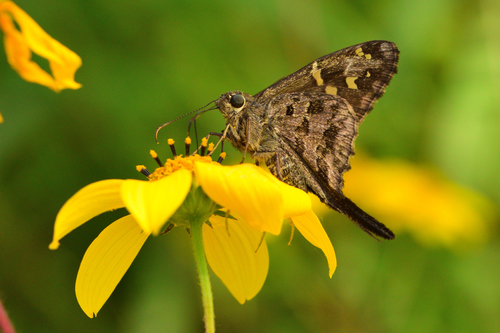
Dorantes Longtail
Cecropterus dorantes
A tropical gem of the southern states, the Dorantes Longtail is a master of high-speed flight and garden camouflage. Recognizable by its elegant hindwing tails and subtle lilac shimmer, it is a rewarding sight for any backyard observer.
Quick Identification
Size
Wingspan of 3.7 to 5.1 cm (1.5 to 2 inches)
Colors
Dark brown upperside with translucent white spots; underside hindwings feature distinctive lilac-gray or lavender bands
Key Features
- Elongated tails on the hindwings
- Lilac-tinted bands on the underside of the wings
- Square-shaped translucent spots on the forewings
- Fast, skipping flight pattern
When You’ll See Them
Geographic range
Where Does the Dorantes Longtail Live?
Native to the Americas, the Dorantes Longtail inhabits a vast territory stretching from Argentina in the south through Central America and Mexico. In the United States, it maintains permanent resident populations in peninsular Florida and southern Texas. During warmer months, it is known as a frequent wanderer, with stray individuals documented as far north as Northern California, Missouri, and the Carolinas.
Basemap © OpenStreetMap contributors
Behavior
The Dorantes Longtail is a member of the skipper family, known for its rapid, darting flight that can make it difficult to track with the naked eye. Unlike many butterflies that flutter gracefully, this species moves with a purposeful, jerky motion, often patrolling garden edges or forest clearings. They are highly active during the sunniest parts of the day, frequently stopping to nectar on a variety of flowering plants or to bask with their wings spread in a characteristic 'V' shape.
As a social species, you will often find multiple individuals congregating around high-quality nectar sources or host plants. They are particularly fond of legumes, which serve as the primary food source for their larvae. While they are not aggressive toward humans, they are wary; a sudden shadow or movement will cause them to zip away into the canopy or thick brush, only to return to the same spot minutes later once the threat has passed.
EverydayEarth exclusive
Camera Tips
To capture the Dorantes Longtail on camera, focus your efforts on 'nectar stations.' Place your AI-powered camera 2 to 3 feet from the ground, directed toward clusters of purple or yellow flowers like Lantana or Porterweed. Because these skippers move incredibly fast, a camera with a high-speed trigger and a high frame rate is essential to avoid motion blur. Position the camera so the sun is behind it; this illuminates the lilac bands on the underside of the wings which are the species' most striking feature.
If you want to film their unique life cycle, move your camera closer to host plants in the legume family, such as Phaseolus (beans). Look for 'leaf shelters'—small sections of leaves folded over and silk-stitched by the caterpillars. Setting your camera to a macro or close-focus mode near these shelters can provide amazing footage of the larvae emerging to feed at night or in the early morning.
For the best lighting, aim for the mid-morning hours between 9:00 AM and 11:00 AM. This is when the butterflies are most active but still spend time basking to warm their flight muscles. If your camera allows for manual focus, set it to the center of a popular flower head, as the skipper's erratic movement can sometimes confuse autofocus sensors mid-flight.
Similar Species
Species that look similar or are commonly confused with Dorantes Longtail.
Frequently Asked Questions
Record Dorantes Longtail at your habitat
Connect a camera to start building your own species record — AI identifies every visitor automatically.