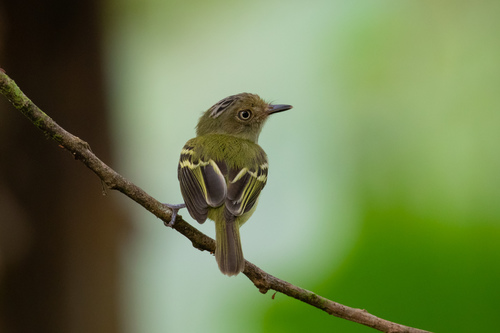
Double-banded Pygmy-Tyrant
Lophotriccus vitiosus
The Double-banded Pygmy-Tyrant is a tiny dynamo of the Amazonian understory, easily identified by its twin yellow wing bars and a signature hover-and-snatch hunting style. This olive-green flycatcher is a master of camouflage, making it a prized 'catch' for backyard forest cameras.
Quick Identification
Size
Approximately 10 cm (3.9 in) in length; weighs between 6-8 grams (0.2-0.3 oz).
Colors
Olive-green upperparts with a greyish crown; pale yellow underparts with faint olive streaking on the chest; features two prominent yellowish-white wing bars.
Key Features
- Two distinct yellowish wing bars
- Small, dark-centered crest often held flat
- Pale yellow iris
- Short, broad-based bill
- Energetic 'hover-gleaning' foraging style
When You’ll See Them
Geographic range
Where Does the Double-banded Pygmy-Tyrant Live?
Native to the northern half of South America, the Double-banded Pygmy-Tyrant is a quintessential resident of the Amazon Basin and the Guiana Shield. Its core territory encompasses the vast rainforests of northern Brazil, eastern Peru, and Ecuador, extending north into Colombia and across the Guianas, including Guyana, Suriname, and French Guiana. This species is a sedentary specialist of tropical lowlands and does not have any known introduced populations outside its native range.
Basemap © OpenStreetMap contributors
Behavior
In terms of social structure, they are typically found alone or in pairs, rarely joining large mixed-species foraging flocks. They are highly territorial and remain in the same area throughout the year. While they aren't especially fearful of humans, their small size and preference for the shaded, dense interior of humid forests make them a challenge to spot without the help of a motion-activated camera or a keen ear for their vocalizations.
EverydayEarth exclusive
Camera Tips
To capture the Double-banded Pygmy-Tyrant, place your camera in the mid-story or understory, ideally between 1 and 2.5 meters (3-8 feet) off the ground. Focus on areas with broad-leafed vegetation where these birds like to forage. Because they are hover-gleaners, look for 'hunting galleries'—clear spaces between dense foliage where the bird has room to maneuver. An upward-tilted camera angle toward the underside of large leaves can catch them in their most iconic pose: the mid-air strike.
Given their tiny size and rapid movements, use the highest sensitivity setting on your PIR sensor. A fast trigger speed (0.2s or less) is essential, or you may only capture an empty branch. If your camera allows for video, set it to a high frame rate (60fps) to slow down their buzzy flight patterns during review. Standard bait doesn't work for these insect-eaters, but a solar-powered water mister or a very shallow, secluded forest birdbath can be a powerful draw.
Lighting is your biggest challenge in the deep forest. Position cameras to take advantage of natural light gaps in the canopy, but avoid direct morning sun which can cause overexposure on their pale yellow bellies. The best footage is usually captured in the 'golden hours' shortly after dawn when the birds are most vocal and active. If your camera has sound-detection triggers, set them to listen for their dry, rattling trill, which often precedes their arrival at a perch.
Similar Species
Species that look similar or are commonly confused with Double-banded Pygmy-Tyrant.
Scale-crested Pygmy-Tyrant
Has a much more prominent crest with rufous/reddish edges that it raises frequently.
Helmeted Pygmy-Tyrant
Has a taller, more pointed crest and lacks the distinct yellowish wing bars of the Double-banded.
Short-tailed Pygmy-Tyrant
Even smaller with a tiny, almost invisible tail and a much more stubby appearance.
Frequently Asked Questions
Record Double-banded Pygmy-Tyrant at your habitat
Connect a camera to start building your own species record — AI identifies every visitor automatically.