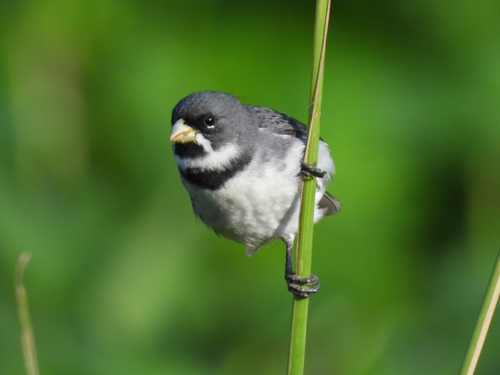
Double-collared Seedeater
Sporophila caerulescens
A beloved South American songbird known for its striking 'double collar' and cheerful, whistling melodies. This adaptable finch-like bird is a frequent visitor to suburban gardens and wild grasslands alike.
Quick Identification
Size
11-12.5 cm (4.3-4.9 inches) in length; weighs approximately 10-14 g (0.35-0.5 oz)
Colors
Males feature grey upperparts, white underparts, and two distinct black bands on the throat and chest. Females are a uniform olive-brown with buff-colored bellies.
Key Features
- Two black bands across the throat and upper breast (males)
- Prominent white 'mustache' or malar stripe
- Small, thick, conical beak for cracking seeds
- Plain olive-brown plumage in females
When You’ll See Them
Geographic range
Where Does the Double-collared Seedeater Live?
The Double-collared Seedeater is native to a vast portion of South America, with its core populations stretching across central and eastern Brazil, through Paraguay and Uruguay, and into northern Argentina. It also thrives in the lowland regions of Bolivia and southeastern Peru. While many populations remain resident throughout the year, those living in the southern temperate zones are partial migrants, moving toward the warmer Amazonian basin during the winter months.
Basemap © OpenStreetMap contributors
Behavior
The Double-collared Seedeater is a highly social and vocal songbird, famous for its sweet, whistling song that often ends in a sharp trill. During the breeding season, males are conspicuously territorial, choosing high perches on grass stalks or fences to sing and defend their nesting sites. They are quite active and can be seen flitting rapidly between food sources.
Outside of the breeding months, these birds often form large, gregarious flocks, sometimes mixing with other seedeater species to forage in open fields. They have adapted well to human presence and are a common sight in suburban gardens and urban parks, though they remain alert and will quickly dive into thick shrubbery if they feel threatened.
EverydayEarth exclusive
Camera Tips
To capture the best footage of a Double-collared Seedeater, position your AI camera at a relatively low height, ideally between 3 to 5 feet. Since these birds spend most of their time foraging on grass seeds, a camera angled toward a patch of tall, native grasses will yield excellent results. If your garden is manicured, consider leaving a small 'wild corner' specifically to attract them.
These birds are particularly fond of water, making a birdbath an essential target for your camera. Place the camera about 6 feet away from a shallow water source to capture their energetic bathing behavior. Because they are small and fast-moving, set your camera to its highest trigger sensitivity and use a short burst mode or high-frame-rate video to avoid blurry images when they take flight.
For baiting, small birdseeds like white millet are highly effective. Scatter the seeds on a flat platform feeder or a clear patch of ground in view of the camera. Early morning is the 'golden hour' for this species; they are most active and vocal just after sunrise. During the spring breeding season, you are more likely to capture the males' distinctive display and singing behavior, while late summer often brings family groups and juveniles to the feeders.
Similar Species
Species that look similar or are commonly confused with Double-collared Seedeater.
Frequently Asked Questions
Record Double-collared Seedeater at your habitat
Connect a camera to start building your own species record — AI identifies every visitor automatically.