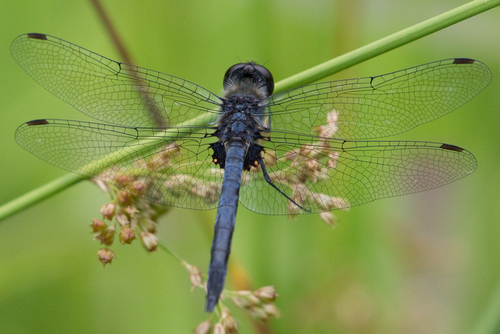
Double-ringed Pennant
Celithemis verna
A gem of the eastern wetlands, the Double-ringed Pennant is a master of the 'sit-and-wait' hunt. This small, elegant skimmer is a favorite for backyard observers who appreciate the intricate beauty of dragonfly wing patterns.
Quick Identification
Size
Length: 30–36 mm (1.2–1.4 in); Wingspan: 50–60 mm (2.0–2.4 in)
Colors
Males are dark blue-black (pruinose) when mature; females and juveniles are golden-brown with two distinct yellow rings on the middle abdominal segments.
Key Features
- Two pale rings on the mid-abdomen of females and juveniles
- Small dark spots at the base and 'nodus' (middle) of each wing
- Frequent perching on the very tips of vertical vegetation
- Slender, tapering abdomen compared to other skimmers
When You’ll See Them
Geographic range
Where Does the Double-ringed Pennant Live?
Native to the North American continent, the Double-ringed Pennant is a specialized resident of the eastern and southeastern United States. Its range is concentrated along the Atlantic Coastal Plain from New Jersey southward to Florida, extending westward through the Gulf States into eastern Texas, Oklahoma, and Kansas. While it is widely distributed, it is often found in localized colonies where specific acidic wetland conditions are met.
Basemap © OpenStreetMap contributors
Behavior
They are most active during the heat of the day, particularly when the sun is brightest. Because they are somewhat sensitive to disturbance, they will frequently fly a short distance away if approached, but their strong site fidelity means they will often return to their favorite twig within minutes. During the breeding season, males are territorial over small patches of shoreline, though they are less aggressive than larger dragonfly species like the Common Pondhawk.
EverydayEarth exclusive
Camera Tips
To capture high-quality images of the Double-ringed Pennant, placement is everything. These dragonflies almost always land on the highest point of a plant. Identify a 'sentinel' stalk—a tall piece of grass or a dead twig that rises above the surrounding vegetation near the water's edge—and position your AI camera to focus on the top 6 inches of that stalk. Use a macro lens if available, as these are small dragonflies that require close-up detail to distinguish from other pennants.
Since dragonflies are cold-blooded, they are most active when the sun is hitting their perching spots. Angle your camera to face north or south to avoid direct lens flare, but ensure the perching site itself is well-illuminated. Early morning is a great time for setups, as the insects may be less flighty while they are still warming up their wing muscles. High shutter speeds (1/1000s or faster) are essential if you want to catch the moment they take off or land.
You can encourage Double-ringed Pennants to visit a specific camera 'studio' by providing the best perch in the area. If you have a backyard pond, place a few slender bamboo stakes or dried flower stalks at the water's edge. Once a dragonfly claims a stake as its territory, it will return to it dozens of times a day. If your camera has a 'fast motion' or 'insect' AI trigger mode, ensure it is enabled to catch the rapid darting behavior characteristic of this species.
Similar Species
Species that look similar or are commonly confused with Double-ringed Pennant.
Calico Pennant
Larger with much more extensive red or yellow heart-shaped spots on the abdomen and larger wing patches.
Halloween Pennant
Easily distinguished by its orange-and-black banded wings and larger size.
Banded Pennant
Features a distinct dark band across the outer third of each wing, which the Double-ringed Pennant lacks.
Frequently Asked Questions
Record Double-ringed Pennant at your habitat
Connect a camera to start building your own species record — AI identifies every visitor automatically.