Douglas-fir
Pseudotsuga menziesii
An icon of the American West, the Douglas-fir is a towering evergreen that serves as a skyscraper for forest wildlife and a cornerstone of the Pacific ecosystem.
Quick Identification
Size
Height 20–100 m (70–330 ft); trunk diameter up to 2.4 m (8 ft)
Colors
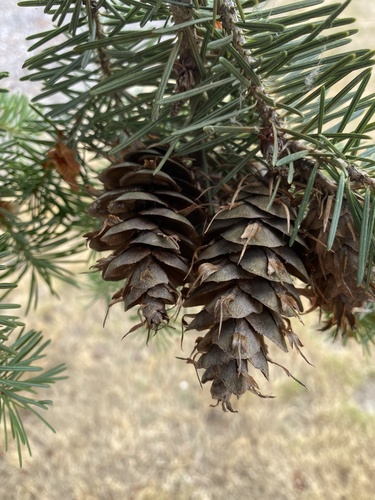
Dark green to blue-green needles; reddish-brown furrowed bark; brown cones with distinct three-pointed bracts
Key Features
- Needles encircle the twig like a bottlebrush
- Cones feature 'mousetail' bracts poking out between scales
- Pointed, reddish-brown buds at the ends of twigs
- Thick, corky bark with deep fissures on mature specimens
When You’ll See Them
Geographic range
Where Does the Douglas-fir Live?
The Douglas-fir is native to the vast wilderness of Western North America, stretching from the lush coastal regions of British Columbia down through the Pacific Northwest and into Central California. It also thrives inland along the spine of the Rocky Mountains, extending south through the United States and into the high-elevation forests of Mexico. While its heartland is the 'Rain Coast' of Oregon and Washington, it has been successfully introduced to Europe, New Zealand, and South America for forestry purposes.
Basemap © OpenStreetMap contributors
Behavior
While the Douglas-fir is stationary, it functions as the anchor of its ecosystem, acting as a vertical highway for wildlife. It is a long-lived species, often reaching several centuries in age, during which it develops a complex canopy architecture that supports specialized species like the Red Tree Vole and various owls. Its growth is rapid in its youth, outcompeting other conifers to reach the sunlight in forest clearings.
Interactions with humans are historically and economically significant; it is one of the world's most important timber species and a favorite for Christmas trees. In a backyard or park setting, it provides dense year-round privacy and wind protection, though its large root system and eventual height mean it requires significant space to thrive without interfering with structures.
EverydayEarth exclusive
Camera Tips
When using a trail camera with a Douglas-fir, think of the tree as a natural tripod and a wildlife hub. Because of their thick, stable trunks, Douglas-firs are the gold standard for mounting cameras. Use a heavy-duty strap to secure your camera at about 3 to 5 feet off the ground for medium-sized mammals, or consider a 'canopy mount' higher up if you are targeting arboreal species like squirrels or Northern Flying Squirrels that use the trunk as a vertical corridor.
Pay close attention to the bark texture; the deep furrows of an older Douglas-fir can sometimes interfere with a camera sitting flush. Use a small wedge of wood or a specialized tilting mount to ensure your lens is angled correctly toward the trail or clearing. If you are aiming to capture birds or squirrels feeding on the cones, position your camera on a nearby branch or a secondary tree about 6-10 feet away to get a wide enough field of view to capture the action without the infrared flash overexposing the subject.
During the winter, the dense evergreen needles of the Douglas-fir provide excellent cover, meaning animals will often huddle near the trunk for protection from snow. This makes the base of the tree a prime location for winter monitoring. Set your camera's trigger speed to its fastest setting, as animals moving up or down the trunk can move surprisingly quickly. If your camera has a time-lapse mode, use it during the spring to document the 'bud burst' as the sharp, reddish tips of the branches explode into soft, lime-green new growth.
Similar Species
Species that look similar or are commonly confused with Douglas-fir.
Western Hemlock
Hemlocks have much smaller cones (1 inch) and a 'drooping' leader at the very top of the tree, unlike the straight top of a Douglas-fir.
Sitka Spruce
Spruce needles are very sharp and stiff to the touch, whereas Douglas-fir needles are soft and flexible.
Grand Fir
Grand Fir needles are arranged in flat, horizontal rows, while Douglas-fir needles encircle the twig in a 'bottlebrush' pattern.
Frequently Asked Questions
Record Douglas-fir at your habitat
Connect a camera to start building your own species record — AI identifies every visitor automatically.